
Choose language / Korean

EN / 한
From Forward Guidance To Market Guidance: Warsh's Reflexive Wrecking Ball?
Bull/Bear Index 46.5/100
macro ▼ Bear Impact 90/100 ZeroHedge 20d ago Read original ↗

From Forward Guidance To Market Guidance: Warsh's Reflexive Wrecking Ball?

How this call is verified

▼ Bearish call was checked against the actual S&P 500 price 24h later: — Flat (-0.16%, below the ±0.3% bar).

Our record on calls like this

1,284 scored calls here, 46.8% right (±9.2pp). Always answering up would have scored 61.8% — so we are -15.0pp.

Bar: S&P 500 ±0.3% within 24h · every verdict lands on the public ledger

AI comment — why bearish

The recent shift in central bank communication, moving from prescriptive forward guidance to more reactive market guidance, introduces a significant element of uncertainty. This recalibration potentially amplifies volatility as market participants attempt to decipher evolving policy intentions based on incoming data. Such a dynamic can foster a more cautious market sentiment, as the predictability of monetary policy diminishes, leading to a recalibration of risk premiums across asset classes. This development is intrinsically linked to broader macro themes of inflation persistence and the ongoing debate surrounding the terminal rate of interest hikes, creating a feedback loop where market reactions influence policy, and policy adjustments, in turn, shape market expectations. Consequently, investor confidence may experience fluctuations, and risk appetite could become more subdued as the path forward appears less defined, prompting a greater emphasis on defensive positioning.

Key takeaway

"From Forward Guidance To Market Guidance: Warsh's Reflexive Wrecking Ball?" — BullBear's AI rates this story as a bearish (negative) signal for markets, with a market-impact score of 90 out of 100. The recent shift in central bank communication, moving from prescriptive forward guidance to more reactive market guidance, introduces a significant element of uncertainty. This recalibration potentially amplifies volatility as market participants attempt to decipher evolving policy intentions based on incoming data. Such a dynamic can foster a more cautious market sentiment, as the predictability of monetary policy diminishes, leading to a recalibration of risk premiums across asset classes. This development is intrinsically linked to broader macro themes of inflation persistence and the ongoing debate surrounding the terminal rate of interest hikes, creating a feedback loop where market reactions influence policy, and policy adjustments, in turn, shape market expectations. Consequently, investor confidence may experience fluctuations, and risk appetite could become more subdued as the path forward appears less defined, prompting a greater emphasis on defensive positioning. That score reflects how strongly the story is likely to move Bitcoin, US equities, the dollar, and gold, and near-duplicate coverage of the same event is clustered so only the representative article is scored. Reported by ZeroHedge on August 04, 2026. The call is verified against the actual 24-hour price move on BullBear's public conviction ledger.

Catch the next bear flag

Telegram alerts when our AI scores a story 80+/100 impact (~1-3 per day, no spam). Verified 30d hit rate 42.6%.

Join Telegram channel

📡 Tomorrow's Watch

Related news

▼ Bear
75/100
ZeroHedge 5h ago

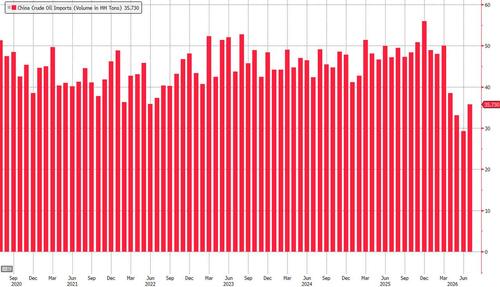
World's Largest Refiner Says China's Oil Demand "Very Likely Peaked Last Year"

Rewritten: China's oil demand likely peaked in 2023, says top refiner.

If China's oil demand truly peaked last year, global refiners could face a structural slowdown in one of their biggest growth markets, prompting a reassessment of supply‑side forecasts and tightening of profit margins across the sector. A perceived ceiling on demand would likely dampen bullish sentiment in energy equities, reinforcing a broader risk‑off tilt that has been gaining traction amid lingering inflationary pressures and tightening monetary policy. The development dovetails with macro trends of decarbonisation, slower economic expansion in Asia and the ongoing shift toward alternative fuels, all of which compound concerns about long‑term demand sustainability. Consequently, investor confidence in oil‑related assets may erode, prompting capital to migrate toward defensive or non‑commodity exposures, and reducing appetite for leverage in energy‑focused portfolios.

If China's oil demand truly peaked last year, global refiners could face a structural slowdown in one of their biggest growth markets, prompting a reassessment of supply‑side forecasts and tightening of profit margins across the sector. A perceived ceiling on demand would likely dampen bullish sentiment in energy equities, reinforcing a broader risk‑off tilt that has been gaining traction amid lingering inflationary pressures and tightening monetary policy. The development dovetails with macro trends of decarbonisation, slower economic expansion in Asia and the ongoing shift toward alternative fuels, all of which compound concerns about long‑term demand sustainability. Consequently, investor confidence in oil‑related assets may erode, prompting capital to migrate toward defensive or non‑commodity exposures, and reducing appetite for leverage in energy‑focused portfolios.

#macro
▼ Bear
80/100
ZeroHedge 10h ago

Supreme Court Backs Trump's Mail-In Ballot Overhaul

Rewritten: Supreme Court Upholds Trump's Mail-In Ballot Reform

The Supreme Court's endorsement of former President Trump's overhaul of mail‑in voting procedures injects heightened political uncertainty into markets, prompting investors to reassess risk exposure ahead of the 2024 election cycle. By reshaping the electoral landscape, the ruling amplifies concerns over policy continuity and could stall legislative agendas, dampening confidence in sectors reliant on stable regulatory environments such as infrastructure and renewable energy. The decision also dovetails with broader macro themes of governance risk and institutional credibility, reinforcing a narrative that political volatility may outweigh the recent momentum from easing inflation pressures. As market participants digest the potential for protracted legal battles and shifting voter dynamics, risk appetite is likely to contract, encouraging a tilt toward defensive assets and safe‑haven currencies while equity valuations face downward pressure.

The Supreme Court's endorsement of former President Trump's overhaul of mail‑in voting procedures injects heightened political uncertainty into markets, prompting investors to reassess risk exposure ahead of the 2024 election cycle. By reshaping the electoral landscape, the ruling amplifies concerns over policy continuity and could stall legislative agendas, dampening confidence in sectors reliant on stable regulatory environments such as infrastructure and renewable energy. The decision also dovetails with broader macro themes of governance risk and institutional credibility, reinforcing a narrative that political volatility may outweigh the recent momentum from easing inflation pressures. As market participants digest the potential for protracted legal battles and shifting voter dynamics, risk appetite is likely to contract, encouraging a tilt toward defensive assets and safe‑haven currencies while equity valuations face downward pressure.

#macro