Choose language / 한국어

EN / 한
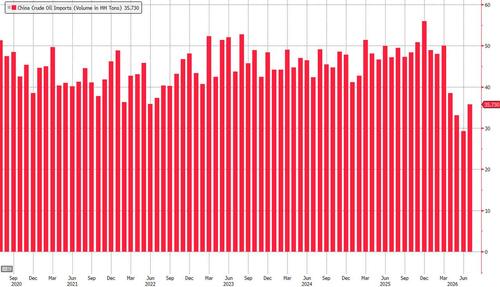
World's Largest Refiner Says China's Oil Demand "Very Likely Peaked Last Year"
Bull/Bear Index 47.4/100
macro ▼ Bear Impact 75/100 ZeroHedge 21d ago Read original ↗

World's Largest Refiner Says China's Oil Demand "Very Likely Peaked Last Year"

How this call is verified

▼ Bearish call was checked against the actual S&P 500 price 24h later: ✗ Miss (+0.32%).

Our record on calls like this

1,151 scored calls here, 46.7% right (±7.6pp). Always answering up would have scored 60.0% on the same rows. Paired within the same day and asset, our directional edge is -0.7 pp ± 6.7 — inside the error bar, i.e. indistinguishable from zero.

Bar: S&P 500 ±0.3% within 24h · every verdict lands on the public ledger

AI comment — why bearish

If China's oil demand truly peaked last year, global refiners could face a structural slowdown in one of their biggest growth markets, prompting a reassessment of supply‑side forecasts and tightening of profit margins across the sector. A perceived ceiling on demand would likely dampen bullish sentiment in energy equities, reinforcing a broader risk‑off tilt that has been gaining traction amid lingering inflationary pressures and tightening monetary policy. The development dovetails with macro trends of decarbonisation, slower economic expansion in Asia and the ongoing shift toward alternative fuels, all of which compound concerns about long‑term demand sustainability. Consequently, investor confidence in oil‑related assets may erode, prompting capital to migrate toward defensive or non‑commodity exposures, and reducing appetite for leverage in energy‑focused portfolios.

Key takeaway

"World's Largest Refiner Says China's Oil Demand "Very Likely Peaked Last Year"" — BullBear's AI rates this story as a bearish (negative) signal for markets, with a market-impact score of 75 out of 100. That score reflects how strongly the story is likely to move Bitcoin, US equities, the dollar, and gold, and near-duplicate coverage of the same event is clustered so only the representative article is scored. Reported by ZeroHedge on August 25, 2026. The call is verified against the actual 24-hour price move on BullBear's public conviction ledger.

Catch the next bear flag

Telegram alerts when our AI scores a story 80+/100 impact (~1-3 per day, no spam). Verified 30d hit rate 42.3%.


Join Telegram channel

📡 Tomorrow's Watch

Related news

▼ Bear
80/100
ZeroHedge 5h ago

BRICS Urges 'Maximum Restraint' As US-Iran War Tests Unity At New Delhi Summit

Amid escalating tensions between the United States and Iran, the BRICS call for maximum restraint signals growing geopolitical friction that could reverberate across global markets. Investors are likely to price in heightened uncertainty, prompting a shift toward safe‑haven assets and dampening demand for risk‑weighted equities, especially in regions exposed to energy price volatility. The discord at the New Delhi summit underscores the fragility of emerging‑market alliances, reinforcing macro themes of supply‑chain disruptions and a potential re‑routing of trade flows away from Western‑led networks. Such developments erode confidence in the stability of cross‑border investment frameworks, curbing risk appetite and potentially triggering capital outflows from frontier markets. In this environment, market sentiment may tilt bearish as participants reassess exposure to commodities, currencies, and equities vulnerable to geopolitical spill‑over effects.

Amid escalating tensions between the United States and Iran, the BRICS call for maximum restraint signals growing geopolitical friction that could reverberate across global markets. Investors are likely to price in heightened uncertainty, prompting a shift toward safe‑haven assets and dampening demand for risk‑weighted equities, especially in regions exposed to energy price volatility. The discord at the New Delhi summit underscores the fragility of emerging‑market alliances, reinforcing macro themes of supply‑chain disruptions and a potential re‑routing of trade flows away from Western‑led networks. Such developments erode confidence in the stability of cross‑border investment frameworks, curbing risk appetite and potentially triggering capital outflows from frontier markets. In this environment, market sentiment may tilt bearish as participants reassess exposure to commodities, currencies, and equities vulnerable to geopolitical spill‑over effects.

#macro
▼ Bear
65/100
ZeroHedge 6h ago

Air Force Secretary Admits US Has Weapons Deployed In Space

An admission by the Air Force Secretary that the United States has deployed weapons in space heightens geopolitical risk and reinforces concerns about an escalating arms race beyond Earth, which could dampen risk‑on sentiment across equity markets. Investors may reinterpret defense spending spikes as a precursor to heightened tensions rather than pure fiscal stimulus, prompting a shift toward safer assets such as Treasury bonds and gold. The development dovetails with broader macro themes of rising great‑power competition, supply‑chain vulnerabilities, and the potential for regulatory scrutiny of commercial space ventures, all of which could compress valuations in technology and aerospace sectors. Consequently, confidence in growth‑oriented equities may erode, and risk appetite could contract as market participants price in the possibility of increased volatility and policy uncertainty in the near term.

An admission by the Air Force Secretary that the United States has deployed weapons in space heightens geopolitical risk and reinforces concerns about an escalating arms race beyond Earth, which could dampen risk‑on sentiment across equity markets. Investors may reinterpret defense spending spikes as a precursor to heightened tensions rather than pure fiscal stimulus, prompting a shift toward safer assets such as Treasury bonds and gold. The development dovetails with broader macro themes of rising great‑power competition, supply‑chain vulnerabilities, and the potential for regulatory scrutiny of commercial space ventures, all of which could compress valuations in technology and aerospace sectors. Consequently, confidence in growth‑oriented equities may erode, and risk appetite could contract as market participants price in the possibility of increased volatility and policy uncertainty in the near term.

#macro