Choose language / Korean

EN / 한
Biden's Illegal Alien Invasion Sparked 30% Home Price Growth, 20% Rent Growth: Fed Paper
Bull/Bear Index 43.9/100
macro ▼ Bear Impact 85/100 ZeroHedge 21d ago Read original ↗

Biden's Illegal Alien Invasion Sparked 30% Home Price Growth, 20% Rent Growth: Fed Paper

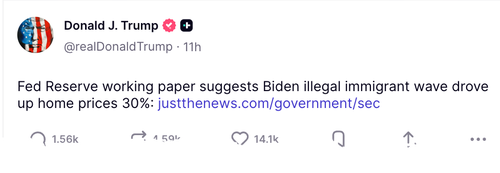
A new Federal Reserve working paper suggests that increased illegal immigration has contributed to a 30% rise in home prices and a 20% rise in rents, adding to the housing affordability crisis.

How this call is verified

▼ Bearish call was checked against the actual S&P 500 price 24h later: ✓ Hit (-0.46%).

Bar: S&P 500 ±0.3% within 24h · every verdict lands on the public ledger

Key takeaway

"Biden's Illegal Alien Invasion Sparked 30% Home Price Growth, 20% Rent Growth: Fed Paper" — BullBear's AI rates this story as a bearish (negative) signal for markets, with a market-impact score of 85 out of 100. A new Federal Reserve working paper suggests that increased illegal immigration has contributed to a 30% rise in home prices and a 20% rise in rents, adding to the housing affordability crisis. Reported by ZeroHedge on July 06, 2026. The call is verified against the actual 24-hour price move on BullBear's public conviction ledger.

Catch the next bear flag

Telegram alerts when our AI scores a story 80+/100 impact (~1-3 per day, no spam). Verified 30d hit rate 51.4%.

Join Telegram channel

📡 Tomorrow's Watch

Related news

▲ Bull
85/100
Google News Macroeconomics (EN) 1h ago

The Federal Reserve is highly unlikely to raise interest rates

Rewritten: Fed likely to hold interest rates steady.

The Federal Reserve is highly unlikely to raise interest rates

The Federal Reserve's indication of pausing interest rate increases suggests a shift towards a less restrictive monetary policy. This change could contribute to a more favorable environment for asset valuations, potentially boosting investor confidence. The market may interpret this as a sign that inflationary pressures are moderating and that economic expansion is becoming more stable, reducing anxieties about a significant economic contraction. This aligns with broader economic trends pointing towards disinflation and a potential easing of global financial conditions. As a result, a more optimistic outlook could emerge, leading to increased interest in riskier assets due to a perceived reduction in downside risks. This adjustment in market expectations might drive greater capital allocation towards equities and other sectors focused on growth, as borrowing costs are expected to remain steady or decrease.

The Federal Reserve's indication of pausing interest rate increases suggests a shift towards a less restrictive monetary policy. This change could contribute to a more favorable environment for asset valuations, potentially boosting investor confidence. The market may interpret this as a sign that inflationary pressures are moderating and that economic expansion is becoming more stable, reducing anxieties about a significant economic contraction. This aligns with broader economic trends pointing towards disinflation and a potential easing of global financial conditions. As a result, a more optimistic outlook could emerge, leading to increased interest in riskier assets due to a perceived reduction in downside risks. This adjustment in market expectations might drive greater capital allocation towards equities and other sectors focused on growth, as borrowing costs are expected to remain steady or decrease.

#macro
▼ Bear
85/100
Google News Macroeconomics (EN) 2h ago

The Fed hawks are winning even without a rate hike - HousingWire

Rewritten: Fed's hawkish stance prevails despite no rate increase.

The Federal Reserve's hawkish stance is prevailing even without an explicit rate hike, suggesting a continued tight monetary policy environment.

The prevailing sentiment surrounding the Federal Reserve's monetary policy stance, characterized by a hawkish inclination despite the absence of immediate interest rate increases, is influencing broader market dynamics. This suggests a sustained commitment to combating inflation, potentially indicating a prolonged period of tighter financial conditions than initially projected. Such a posture is consistent with prevailing macroeconomic considerations, including persistent inflationary pressures and the possibility of an economic slowdown. As a result, investor sentiment may experience a dampening effect, leading to a decreased inclination towards higher-risk investments as market participants adjust their outlooks on future economic expansion and the path of interest rates. The market's interpretation of the central bank's communications is thus emerging as a significant determinant of near-term asset performance and long-term investment strategies.

The prevailing sentiment surrounding the Federal Reserve's monetary policy stance, characterized by a hawkish inclination despite the absence of immediate interest rate increases, is influencing broader market dynamics. This suggests a sustained commitment to combating inflation, potentially indicating a prolonged period of tighter financial conditions than initially projected. Such a posture is consistent with prevailing macroeconomic considerations, including persistent inflationary pressures and the possibility of an economic slowdown. As a result, investor sentiment may experience a dampening effect, leading to a decreased inclination towards higher-risk investments as market participants adjust their outlooks on future economic expansion and the path of interest rates. The market's interpretation of the central bank's communications is thus emerging as a significant determinant of near-term asset performance and long-term investment strategies.

#macro
▼ Bear
65/100
MishTalk 2h ago

Trump’s Tariffs Didn’t Improve the Deficit but Did Increase Consumer Costs

Rewritten: Tariffs raised consumer costs, not deficit reduction.

The undeniable truth is easy to see in pictures.

The observation that trade deficits have not narrowed following the imposition of tariffs indicates that these protectionist policies may not be achieving their intended macroeconomic goals. This outcome could foster a more cautious outlook among market participants, particularly concerning industries deeply integrated into global supply chains. Investors might become more hesitant to allocate capital to these sectors, anticipating potential headwinds from ongoing trade disputes and their impact on international commerce. This scenario, coupled with existing inflationary pressures and concerns about supply chain stability, could further erode consumer spending power and affect corporate earnings. Consequently, a shift towards more conservative investment strategies and a reduced tolerance for speculative assets might become evident as market sentiment recalibrates.

The observation that trade deficits have not narrowed following the imposition of tariffs indicates that these protectionist policies may not be achieving their intended macroeconomic goals. This outcome could foster a more cautious outlook among market participants, particularly concerning industries deeply integrated into global supply chains. Investors might become more hesitant to allocate capital to these sectors, anticipating potential headwinds from ongoing trade disputes and their impact on international commerce. This scenario, coupled with existing inflationary pressures and concerns about supply chain stability, could further erode consumer spending power and affect corporate earnings. Consequently, a shift towards more conservative investment strategies and a reduced tolerance for speculative assets might become evident as market sentiment recalibrates.

#macro