Choose language / 한국어

EN / 한
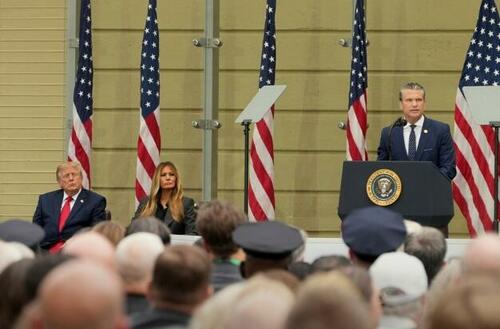
Trump & Hegseth Try To Tie Iran To 9/11 At Pentagon Ceremony
Bull/Bear Index 46.3/100
macro ▼ Bear Impact 62/100 ZeroHedge 9h ago Read original ↗

Trump & Hegseth Try To Tie Iran To 9/11 At Pentagon Ceremony

How this call is verified

The ▼ Bearish call is auto-verified against the actual S&P 500 price in ~15h.

Our record on calls like this

1,148 scored calls here, 46.6% right (±7.6pp). Always answering up would have scored 60.2% on the same rows. Paired within the same day and asset, our directional edge is -0.7 pp ± 6.7 — inside the error bar, i.e. indistinguishable from zero.

Bar: S&P 500 ±0.3% within 24h · every verdict lands on the public ledger

AI comment — why bearish

Heightened political rhetoric linking Iran to the September 11 attacks injects fresh geopolitical tension into an already fragile global backdrop, prompting investors to reassess exposure to emerging‑market equities and energy commodities that are sensitive to Middle‑East instability. The spectacle of senior officials using a Pentagon ceremony to advance a narrative of culpability may amplify concerns over potential escalation, feeding a risk‑off bias that typically benefits safe‑haven assets such as U.S. Treasuries and gold. At the macro level, the episode dovetails with broader themes of rising great‑power competition and the uncertainty surrounding diplomatic channels, reinforcing expectations of tighter risk premiums across asset classes. Consequently, confidence among risk‑tolerant investors could wane, curbing appetite for equities and high‑yield credit while encouraging a shift toward defensive positions as market participants brace for possible policy‑driven volatility.

Key takeaway

"Trump & Hegseth Try To Tie Iran To 9/11 At Pentagon Ceremony" — BullBear's AI rates this story as a bearish (negative) signal for markets, with a market-impact score of 62 out of 100. That score reflects how strongly the story is likely to move Bitcoin, US equities, the dollar, and gold, and near-duplicate coverage of the same event is clustered so only the representative article is scored. Reported by ZeroHedge on September 12, 2026. The call is verified against the actual 24-hour price move on BullBear's public conviction ledger.

Catch the next bear flag

Telegram alerts when our AI scores a story 80+/100 impact (~1-3 per day, no spam). Verified 30d hit rate 42.0%.

Join Telegram channel

📡 Tomorrow's Watch

Related news

#macro
▼ Bear
85/100
MishTalk 11h ago

Will Trump Summon Warsh to the White House Ahead of Fed Meeting?

Speculation that former President Trump may bring former Fed governor William “Bill” Warsh into the White House just before the upcoming Federal Reserve policy meeting fuels heightened market uncertainty, as investors weigh the prospect of a more dovish or politically driven monetary stance. Such a move could signal an attempt to influence interest‑rate decisions, potentially undermining the Fed’s perceived independence and prompting a reassessment of inflation expectations. In the broader context of lingering supply‑chain disruptions and geopolitical tensions, the perceived politicization of monetary policy may dampen risk appetite, prompting a shift toward defensive assets and widening credit spreads. Investor confidence could erode as market participants question the stability of the policy framework, leading to increased volatility in equities and a cautious stance on rate‑sensitive sectors. Overall, the narrative reinforces bearish sentiment amid concerns over policy credibility and macro‑economic stability.

Speculation that former President Trump may bring former Fed governor William “Bill” Warsh into the White House just before the upcoming Federal Reserve policy meeting fuels heightened market uncertainty, as investors weigh the prospect of a more dovish or politically driven monetary stance. Such a move could signal an attempt to influence interest‑rate decisions, potentially undermining the Fed’s perceived independence and prompting a reassessment of inflation expectations. In the broader context of lingering supply‑chain disruptions and geopolitical tensions, the perceived politicization of monetary policy may dampen risk appetite, prompting a shift toward defensive assets and widening credit spreads. Investor confidence could erode as market participants question the stability of the policy framework, leading to increased volatility in equities and a cautious stance on rate‑sensitive sectors. Overall, the narrative reinforces bearish sentiment amid concerns over policy credibility and macro‑economic stability.

#macro
▼ Bear
78/100
ZeroHedge 1d ago

PLA Purge May Be Driving China To Rely More On Military Pressure Against Taiwan: Analysts

Heightened internal political turmoil in China, reflected in a crackdown on the People’s Liberation Army, could push Beijing to lean more heavily on military coercion toward Taiwan, a development that reverberates across global equities and fixed‑income markets. Investors may interpret the shift as a signal of increased geopolitical risk, prompting a rotation out of risk‑on assets such as Chinese tech stocks and into safe‑haven currencies and Treasury bonds. The move dovetails with broader macro narratives of rising great‑power competition, supply‑chain realignment, and a potential decoupling of China from Western markets, reinforcing concerns about trade disruptions and regulatory unpredictability. As confidence in the stability of Chinese policy erodes, risk appetite is likely to contract, leading to higher volatility premiums and a cautious stance among institutional and retail investors alike.

Heightened internal political turmoil in China, reflected in a crackdown on the People’s Liberation Army, could push Beijing to lean more heavily on military coercion toward Taiwan, a development that reverberates across global equities and fixed‑income markets. Investors may interpret the shift as a signal of increased geopolitical risk, prompting a rotation out of risk‑on assets such as Chinese tech stocks and into safe‑haven currencies and Treasury bonds. The move dovetails with broader macro narratives of rising great‑power competition, supply‑chain realignment, and a potential decoupling of China from Western markets, reinforcing concerns about trade disruptions and regulatory unpredictability. As confidence in the stability of Chinese policy erodes, risk appetite is likely to contract, leading to higher volatility premiums and a cautious stance among institutional and retail investors alike.

#macro