Choose language / 한국어

EN / 한
Bull/Bear Index 48.3/100
macro ▼ Bear Impact 35/100 U.S. Federal Register 12h ago Read original ↗

U.S. Treasury Issues New Iranian Transactions and Sanctions Regulations

On September 10, 2026, the Treasury Department’s Office of Foreign Assets Control released a new rule governing Iranian transactions and sanctions.

AI comment — why bearish

The new OFAC rule on Iranian transactions is likely to tighten compliance requirements, which could depress the share prices of firms with exposure to Iran. Because the rule’s specific provisions have not been disclosed, the exact magnitude of the impact remains uncertain. In the short term, market participants may sell off securities tied to Iranian trade or to companies that could be affected by heightened sanctions. Firms will probably need to review and possibly restructure existing contracts to remain compliant, adding operational costs. However, the broader market is expected to stay largely insulated given the rule’s narrow focus on Iran‑related activities.

Key takeaway

"U.S. Treasury Issues New Iranian Transactions and Sanctions Regulations" — BullBear's AI rates this story as a bearish (negative) signal for markets, with a market-impact score of 35 out of 100. That score reflects how strongly the story is likely to move Bitcoin, US equities, the dollar, and gold, and near-duplicate coverage of the same event is clustered so only the representative article is scored. Reported by U.S. Federal Register on September 10, 2026. The call is verified against the actual 24-hour price move on BullBear's public conviction ledger.

Catch the next bear flag

Telegram alerts when our AI scores a story 80+/100 impact (~1-3 per day, no spam). Verified 30d hit rate 46.0%.


Join Telegram channel

📡 Tomorrow's Watch

Related news

▲ Bull
65/100
ZeroHedge 10h ago

NextEra Secures $1.9BN Loan From Dept Of Energy For Restart Of Duane Arnold Nuclear Power Plant

The financing of a $1.9 billion loan from the Department of Energy to restart the Duane Arnold nuclear plant signals renewed federal support for legacy clean‑energy assets, reinforcing the broader trend of diversifying the power mix amid tightening emissions standards. By unlocking capital for an existing facility, the move may encourage other operators to consider similar refurbishments, potentially expanding the pipeline of domestic nuclear capacity and bolstering the long‑term supply outlook for baseload electricity. Market sentiment could shift modestly more positive toward energy infrastructure equities, as investors interpret the commitment as a vote of confidence in policy stability and the viability of nuclear as a low‑carbon hedge. This aligns with macro themes of decarbonization, energy security, and infrastructure spending, which together may lift risk appetite for projects with government backing while tempering concerns over the transition’s financing gaps.

The financing of a $1.9 billion loan from the Department of Energy to restart the Duane Arnold nuclear plant signals renewed federal support for legacy clean‑energy assets, reinforcing the broader trend of diversifying the power mix amid tightening emissions standards. By unlocking capital for an existing facility, the move may encourage other operators to consider similar refurbishments, potentially expanding the pipeline of domestic nuclear capacity and bolstering the long‑term supply outlook for baseload electricity. Market sentiment could shift modestly more positive toward energy infrastructure equities, as investors interpret the commitment as a vote of confidence in policy stability and the viability of nuclear as a low‑carbon hedge. This aligns with macro themes of decarbonization, energy security, and infrastructure spending, which together may lift risk appetite for projects with government backing while tempering concerns over the transition’s financing gaps.

#macro
▼ Bear
75/100
ZeroHedge 13h ago

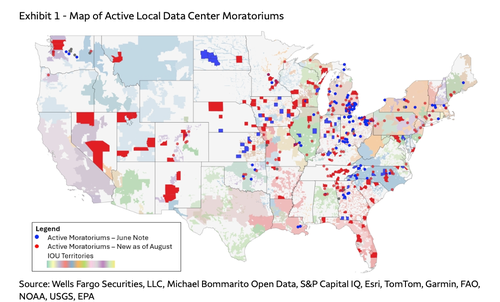
Data Center Revolt Accelerates Ahead Of Midterms As Wells Fargo Warns Of Fourfold Jump In Active Moratoriums

Rising opposition to data center expansions, highlighted by a surge in active moratoriums, signals a tightening regulatory environment that could constrain supply‑side growth in the tech infrastructure sector. As the issue gains traction ahead of the midterm elections, investors may interpret the heightened scrutiny as a proxy for broader policy uncertainty, dampening enthusiasm for related equities and REITs. The development dovetails with macro‑level concerns about energy consumption, climate mandates, and the fiscal outlook, reinforcing narratives of slower capital deployment in high‑intensity assets. Consequently, market sentiment may shift toward caution, with risk‑averse capital gravitating away from sectors perceived as vulnerable to regulatory headwinds. This dynamic could erode confidence among investors seeking stable returns, prompting a recalibration of risk appetite toward more defensively positioned industries.

Rising opposition to data center expansions, highlighted by a surge in active moratoriums, signals a tightening regulatory environment that could constrain supply‑side growth in the tech infrastructure sector. As the issue gains traction ahead of the midterm elections, investors may interpret the heightened scrutiny as a proxy for broader policy uncertainty, dampening enthusiasm for related equities and REITs. The development dovetails with macro‑level concerns about energy consumption, climate mandates, and the fiscal outlook, reinforcing narratives of slower capital deployment in high‑intensity assets. Consequently, market sentiment may shift toward caution, with risk‑averse capital gravitating away from sectors perceived as vulnerable to regulatory headwinds. This dynamic could erode confidence among investors seeking stable returns, prompting a recalibration of risk appetite toward more defensively positioned industries.

#macro