Choose language / Korean

EN / 한
Trump Considers New Tariffs On Semiconductors - Reports Raise Alarm Could Doom US Dominance
Bull/Bear Index 47.8/100
macro ▼ Bear Impact 75/100 ZeroHedge 3h ago Read original ↗

Trump Considers New Tariffs On Semiconductors - Reports Raise Alarm Could Doom US Dominance

How this call is verified

The ▼ Bearish call is auto-verified against the actual S&P 500 price in ~21h.

Our record on calls like this

1,295 scored calls here, 46.5% right (±9.1pp). Always answering up would have scored 62.2% — so we are -15.7pp.

Bar: S&P 500 ±0.3% within 24h · every verdict lands on the public ledger

AI comment — why bearish

Potential new tariffs on semiconductors would reverberate across technology supply chains, tightening cost structures for manufacturers and prompting firms to reassess overseas production strategies. Such protectionist signals tend to dampen equity momentum in hardware‑related sectors, while amplifying volatility in broader indices as investors weigh the prospect of reduced export competitiveness. The move dovetails with a resurgence of trade‑policy uncertainty that already challenges the post‑pandemic macro environment, intersecting with inflationary pressures and a slowing global growth outlook. Consequently, confidence among capital allocators may erode, prompting a shift toward defensive assets and a lower appetite for risk‑weighted positions in growth‑oriented stocks. The heightened geopolitical risk premium could also compress valuation multiples, as market participants price in the likelihood of supply disruptions and longer‑term strategic realignments across both domestic and international markets. Investors will likely monitor policy developments closely, adjusting exposure to sectors most vulnerable to tariff escalations.

Key takeaway

"Trump Considers New Tariffs On Semiconductors - Reports Raise Alarm Could Doom US Dominance" — BullBear's AI rates this story as a bearish (negative) signal for markets, with a market-impact score of 75 out of 100. Potential new tariffs on semiconductors would reverberate across technology supply chains, tightening cost structures for manufacturers and prompting firms to reassess overseas production strategies. Such protectionist signals tend to dampen equity momentum in hardware‑related sectors, while amplifying volatility in broader indices as investors weigh the prospect of reduced export competitiveness. The move dovetails with a resurgence of trade‑policy uncertainty that already challenges the post‑pandemic macro environment, intersecting with inflationary pressures and a slowing global growth outlook. Consequently, confidence among capital allocators may erode, prompting a shift toward defensive assets and a lower appetite for risk‑weighted positions in growth‑oriented stocks. The heightened geopolitical risk premium could also compress valuation multiples, as market participants price in the likelihood of supply disruptions and longer‑term strategic realignments across both domestic and international markets. Investors will likely monitor policy developments closely, adjusting exposure to sectors most vulnerable to tariff escalations. That score reflects how strongly the story is likely to move Bitcoin, US equities, the dollar, and gold, and near-duplicate coverage of the same event is clustered so only the representative article is scored. Reported by ZeroHedge on August 27, 2026. The call is verified against the actual 24-hour price move on BullBear's public conviction ledger.

Catch the next bear flag

Telegram alerts when our AI scores a story 80+/100 impact (~1-3 per day, no spam). Verified 30d hit rate 43.1%.

Join Telegram channel

📡 Tomorrow's Watch

Related news

▲ Bull
80/100
ZeroHedge 4h ago

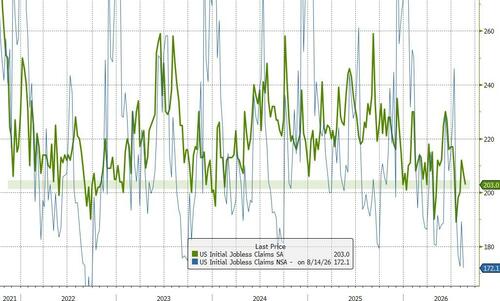
Jobs 'AI'pocalypse No! Initial Jobless Claims Hover Near Record Lows

Rewritten: Jobless claims stay near record lows, no AI-driven employment crisis

Persistently low initial jobless claims signal a labor market that remains resilient despite automation concerns, reinforcing expectations of continued consumer spending and corporate earnings growth. Such data bolsters confidence in the underlying economic momentum, encouraging a tilt toward risk‑on positioning among equity investors while tempering defensive biases. The strength of employment aligns with broader macro narratives of a gradual, demand‑driven recovery and supports the view that monetary policy may remain accommodative longer than anticipated. Consequently, investor sentiment is likely to stay upbeat, sustaining inflows into growth‑oriented sectors and maintaining elevated valuations. However, the juxtaposition of robust hiring with ongoing AI integration raises questions about future productivity gains and potential sectoral shifts, prompting a nuanced assessment of long‑term risk appetite overall.

Persistently low initial jobless claims signal a labor market that remains resilient despite automation concerns, reinforcing expectations of continued consumer spending and corporate earnings growth. Such data bolsters confidence in the underlying economic momentum, encouraging a tilt toward risk‑on positioning among equity investors while tempering defensive biases. The strength of employment aligns with broader macro narratives of a gradual, demand‑driven recovery and supports the view that monetary policy may remain accommodative longer than anticipated. Consequently, investor sentiment is likely to stay upbeat, sustaining inflows into growth‑oriented sectors and maintaining elevated valuations. However, the juxtaposition of robust hiring with ongoing AI integration raises questions about future productivity gains and potential sectoral shifts, prompting a nuanced assessment of long‑term risk appetite overall.

#macro
▼ Bear
65/100
ZeroHedge 7h ago

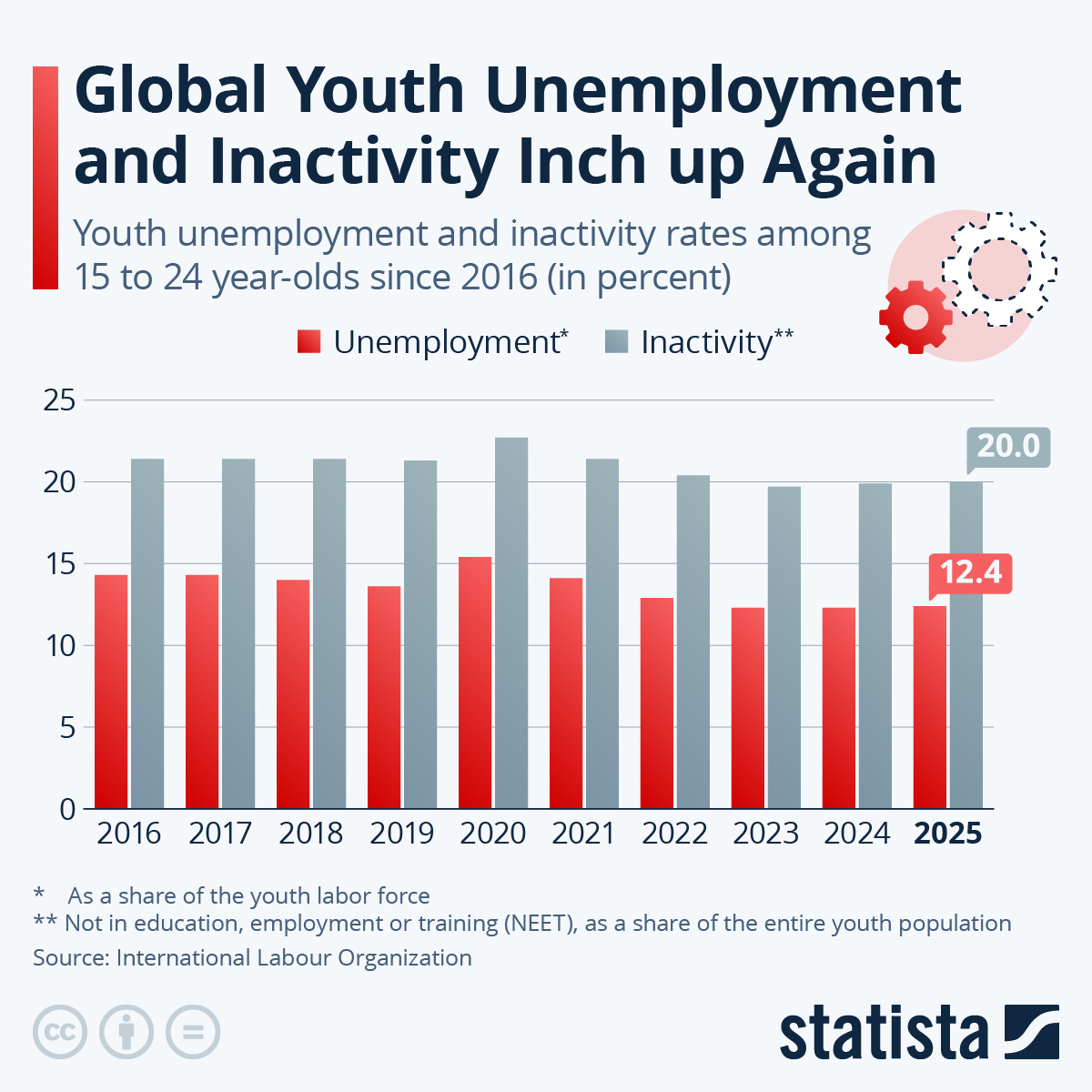
Global Youth Unemployment And Inactivity Inch Up Again

Rewritten: Global youth joblessness and idleness rise slightly.

The continued upward trajectory of youth unemployment and labor‑force inactivity across multiple regions introduces a subtle but significant variable into macroeconomic assessments. Reduced employment prospects for younger cohorts can suppress disposable income and limit consumption, which traditionally fuels demand‑driven growth and supports corporate revenue streams. At the same time, a disengaged segment of the future workforce may constrain the pool of talent available for innovation and productivity gains, potentially slowing the pace of technological adoption and efficiency improvements. These dynamics intersect with broader demographic trends, such as aging populations and shifting labor‑market structures, prompting analysts to re‑examine assumptions about long‑term growth potential. As the implications of a less active younger demographic become clearer, market participants may exhibit heightened caution, gravitating toward assets perceived as more resilient to slower economic expansion and reduced consumer momentum.

The continued upward trajectory of youth unemployment and labor‑force inactivity across multiple regions introduces a subtle but significant variable into macroeconomic assessments. Reduced employment prospects for younger cohorts can suppress disposable income and limit consumption, which traditionally fuels demand‑driven growth and supports corporate revenue streams. At the same time, a disengaged segment of the future workforce may constrain the pool of talent available for innovation and productivity gains, potentially slowing the pace of technological adoption and efficiency improvements. These dynamics intersect with broader demographic trends, such as aging populations and shifting labor‑market structures, prompting analysts to re‑examine assumptions about long‑term growth potential. As the implications of a less active younger demographic become clearer, market participants may exhibit heightened caution, gravitating toward assets perceived as more resilient to slower economic expansion and reduced consumer momentum.

#macro
▲ Bull
85/100
ZeroHedge 14h ago

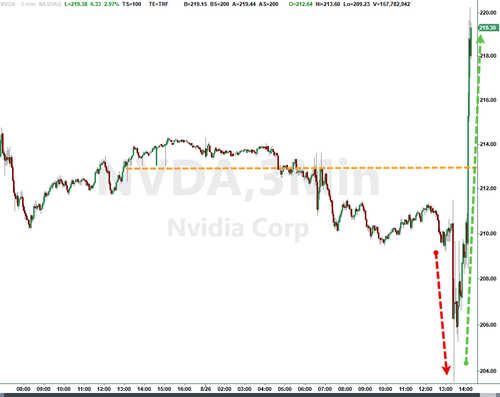
Nvidia Rises After Solid Earnings, Reversing Margin Concerns As Company Guides To 70% 2028 Revenue Growth

Rewritten: Nvidia shares rise after earnings, easing margin worries, 70% growth by 2028

Investors are likely to interpret Nvidia's earnings beat and forward‑looking guidance as a catalyst for renewed optimism in the broader technology sector, potentially lifting risk‑on sentiment across equity markets. By projecting a 70% revenue surge by 2028, the company signals confidence in sustained demand for AI‑driven hardware, reinforcing macro trends that link semiconductor growth to expanding cloud, data‑center, and generative‑AI deployments. This narrative may encourage capital allocation toward high‑growth, capital‑intensive firms, narrowing the spread between growth and value stocks as confidence in long‑term margins improves. At the same time, the reversal of earlier margin concerns could temper defensive positioning, prompting investors to increase exposure to cyclical and speculative assets. Overall, the upbeat outlook strengthens market confidence in the tech pipeline, supporting a more aggressive risk appetite while still leaving room for caution amid broader economic uncertainties.

Investors are likely to interpret Nvidia's earnings beat and forward‑looking guidance as a catalyst for renewed optimism in the broader technology sector, potentially lifting risk‑on sentiment across equity markets. By projecting a 70% revenue surge by 2028, the company signals confidence in sustained demand for AI‑driven hardware, reinforcing macro trends that link semiconductor growth to expanding cloud, data‑center, and generative‑AI deployments. This narrative may encourage capital allocation toward high‑growth, capital‑intensive firms, narrowing the spread between growth and value stocks as confidence in long‑term margins improves. At the same time, the reversal of earlier margin concerns could temper defensive positioning, prompting investors to increase exposure to cyclical and speculative assets. Overall, the upbeat outlook strengthens market confidence in the tech pipeline, supporting a more aggressive risk appetite while still leaving room for caution amid broader economic uncertainties.

#macro