Choose language / Korean

EN / 한
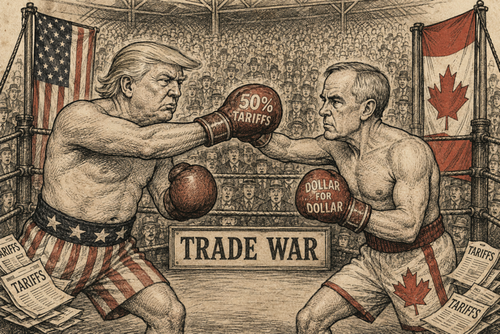
We Don't Need Canada: Loonie Limps Lower As Trump Unleashes (More) Tariffs
Bull/Bear Index 46.3/100
macro ▼ Bear Impact 70/100 ZeroHedge 2h ago Read original ↗

We Don't Need Canada: Loonie Limps Lower As Trump Unleashes (More) Tariffs

How this call is verified

The ▼ Bearish call is auto-verified against the actual S&P 500 price in ~22h.

Our record on calls like this

1,284 scored calls here, 46.8% right (±9.2pp). Always answering up would have scored 61.8% — so we are -15.0pp.

Bar: S&P 500 ±0.3% within 24h · every verdict lands on the public ledger

AI comment — why bearish

With the Canadian dollar slipping as new U.S. tariff measures gain momentum, equity markets are likely to register heightened volatility, especially in sectors reliant on cross‑border supply chains. The depreciation signals that trade friction remains a salient risk, reinforcing a broader risk‑off bias that has been gaining traction among global investors. By amplifying concerns over protectionist policies, the development dovetails with macro narratives of slowing growth and elevated inflationary pressure, prompting central banks to maintain tighter monetary stances. Consequently, confidence among investors in emerging‑market assets and commodity‑linked exposures may erode, while demand for safe‑haven currencies and short‑duration instruments could rise. The overall risk appetite is expected to contract, as market participants reassess exposure to trade‑sensitive economies and recalibrate portfolio allocations toward defensive positions.

Key takeaway

"We Don't Need Canada: Loonie Limps Lower As Trump Unleashes (More) Tariffs" — BullBear's AI rates this story as a bearish (negative) signal for markets, with a market-impact score of 70 out of 100. With the Canadian dollar slipping as new U.S. tariff measures gain momentum, equity markets are likely to register heightened volatility, especially in sectors reliant on cross‑border supply chains. The depreciation signals that trade friction remains a salient risk, reinforcing a broader risk‑off bias that has been gaining traction among global investors. By amplifying concerns over protectionist policies, the development dovetails with macro narratives of slowing growth and elevated inflationary pressure, prompting central banks to maintain tighter monetary stances. Consequently, confidence among investors in emerging‑market assets and commodity‑linked exposures may erode, while demand for safe‑haven currencies and short‑duration instruments could rise. The overall risk appetite is expected to contract, as market participants reassess exposure to trade‑sensitive economies and recalibrate portfolio allocations toward defensive positions. That score reflects how strongly the story is likely to move Bitcoin, US equities, the dollar, and gold, and near-duplicate coverage of the same event is clustered so only the representative article is scored. Reported by ZeroHedge on August 24, 2026. The call is verified against the actual 24-hour price move on BullBear's public conviction ledger.

Catch the next bear flag

Telegram alerts when our AI scores a story 80+/100 impact (~1-3 per day, no spam). Verified 30d hit rate 42.8%.

Join Telegram channel

📡 Tomorrow's Watch

Related news

▼ Bear
72/100
ZeroHedge 3h ago

Macron Vows To Fast-Track More Missile Interceptors For Ukraine After Deadly Mall Strike

Rewritten: Macron pledges quicker delivery of missile interceptors to Ukraine after mall attack

The acceleration of Western missile‑interceptor deliveries to Ukraine reflects a deepening involvement in a conflict that appears likely to endure, reinforcing expectations of prolonged geopolitical volatility. Such an escalation in defense cooperation is poised to keep sovereign and corporate budgets under pressure as nations allocate additional resources to security spending, which may translate into higher fiscal deficits and upward pressure on inflation. Supply‑chain constraints could intensify if manufacturing capacity is redirected toward military production, while heightened risk of spill‑over effects raises concerns about broader economic disruption. Consequently, market participants may adopt a more cautious stance, favoring lower‑volatility assets and defensive positioning as uncertainty about fiscal policy, commodity demand and regional stability persists. The cumulative effect of sustained defense outlays and the attendant macro‑economic headwinds could dampen risk appetite across equity and credit markets, reinforcing a bearish bias in sentiment.

The acceleration of Western missile‑interceptor deliveries to Ukraine reflects a deepening involvement in a conflict that appears likely to endure, reinforcing expectations of prolonged geopolitical volatility. Such an escalation in defense cooperation is poised to keep sovereign and corporate budgets under pressure as nations allocate additional resources to security spending, which may translate into higher fiscal deficits and upward pressure on inflation. Supply‑chain constraints could intensify if manufacturing capacity is redirected toward military production, while heightened risk of spill‑over effects raises concerns about broader economic disruption. Consequently, market participants may adopt a more cautious stance, favoring lower‑volatility assets and defensive positioning as uncertainty about fiscal policy, commodity demand and regional stability persists. The cumulative effect of sustained defense outlays and the attendant macro‑economic headwinds could dampen risk appetite across equity and credit markets, reinforcing a bearish bias in sentiment.

#macro
▼ Bear
70/100
ZeroHedge 4h ago

Gold Jumps, Curve Flattens On Report Treasury To Tap Trillion-Dollar TGA To Fund Bond Buybacks

Rewritten: Gold rises, yield curve flattens as Treasury taps TGA for buybacks.

Gold’s rally and the flattening of the Treasury yield curve signal heightened uncertainty as the Treasury plans to draw on the trillion‑dollar Treasury General Account to finance bond repurchases. By draining cash reserves, the move could tighten liquidity in short‑term funding markets, pressuring short‑term rates upward while keeping long‑term yields subdued, a pattern often interpreted as a warning of slower growth. The surge in safe‑haven demand for gold reflects investors’ wariness of potential fiscal strain and the prospect of tighter monetary conditions. Consequently, risk‑off sentiment may intensify, prompting a shift away from equities and higher‑yield assets toward defensive positions. The episode underscores broader macro concerns about fiscal sustainability, the interplay between Treasury actions and Federal Reserve policy, and the fragility of confidence in the near‑term risk appetite of market participants.

Gold’s rally and the flattening of the Treasury yield curve signal heightened uncertainty as the Treasury plans to draw on the trillion‑dollar Treasury General Account to finance bond repurchases. By draining cash reserves, the move could tighten liquidity in short‑term funding markets, pressuring short‑term rates upward while keeping long‑term yields subdued, a pattern often interpreted as a warning of slower growth. The surge in safe‑haven demand for gold reflects investors’ wariness of potential fiscal strain and the prospect of tighter monetary conditions. Consequently, risk‑off sentiment may intensify, prompting a shift away from equities and higher‑yield assets toward defensive positions. The episode underscores broader macro concerns about fiscal sustainability, the interplay between Treasury actions and Federal Reserve policy, and the fragility of confidence in the near‑term risk appetite of market participants.

#macro