Choose language / Korean

EN / 한
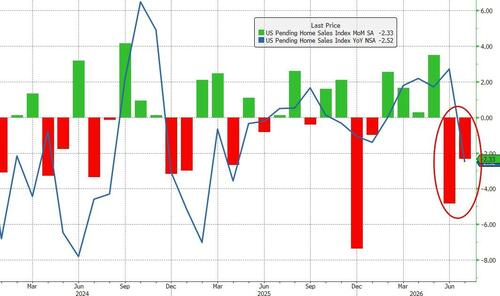
US Pending Home Sales Plunge Back Near Record Lows In July
Bull/Bear Index 47.6/100
macro ▼ Bear Impact 65/100 ZeroHedge 3h ago Read original ↗

US Pending Home Sales Plunge Back Near Record Lows In July

How this call is verified

The ▼ Bearish call is auto-verified against the actual S&P 500 price in ~21h.

Our record on calls like this

1,263 scored calls here, 46.6% right (±9.3pp). Always answering up would have scored 62.2% — so we are -15.6pp.

Bar: S&P 500 ±0.3% within 24h · every verdict lands on the public ledger

AI comment — why bearish

A sharp decline in pending home sales for July, slipping toward historic lows, signals weakening demand in the United States housing market, a sector that traditionally underpins consumer confidence. The slowdown dovetails with higher mortgage rates, lingering inflation pressures and tighter credit conditions, reinforcing concerns that the broader economy may be losing momentum. Investors are likely to interpret the data as a warning sign for discretionary spending, prompting a shift toward defensive assets and heightened scrutiny of real‑estate‑linked equities. Diminished optimism around housing also feeds into a broader risk‑off sentiment, potentially curbing appetite for higher‑yield, higher‑beta positions. As the housing market often acts as a leading indicator, the persistent weakness could erode confidence in near‑term growth forecasts, prompting a more cautious stance across equity and fixed‑income markets.

Key takeaway

"US Pending Home Sales Plunge Back Near Record Lows In July" — BullBear's AI rates this story as a bearish (negative) signal for markets, with a market-impact score of 65 out of 100. A sharp decline in pending home sales for July, slipping toward historic lows, signals weakening demand in the United States housing market, a sector that traditionally underpins consumer confidence. The slowdown dovetails with higher mortgage rates, lingering inflation pressures and tighter credit conditions, reinforcing concerns that the broader economy may be losing momentum. Investors are likely to interpret the data as a warning sign for discretionary spending, prompting a shift toward defensive assets and heightened scrutiny of real‑estate‑linked equities. Diminished optimism around housing also feeds into a broader risk‑off sentiment, potentially curbing appetite for higher‑yield, higher‑beta positions. As the housing market often acts as a leading indicator, the persistent weakness could erode confidence in near‑term growth forecasts, prompting a more cautious stance across equity and fixed‑income markets. That score reflects how strongly the story is likely to move Bitcoin, US equities, the dollar, and gold, and near-duplicate coverage of the same event is clustered so only the representative article is scored. Reported by ZeroHedge on August 18, 2026. The call is verified against the actual 24-hour price move on BullBear's public conviction ledger.

Catch the next bear flag

Telegram alerts when our AI scores a story 80+/100 impact (~1-3 per day, no spam). Verified 30d hit rate 46.5%.

Join Telegram channel

📡 Tomorrow's Watch

Related news

▼ Bear
78/100
ZeroHedge 1h ago

Moscow Swarmed By 600+ Ukrainian Drones In Massive Overnight Barrage

Rewritten: Over 600 Ukrainian drones bombarded Moscow overnight

Escalating hostilities in Eastern Europe are likely to reverberate across global markets, as the unprecedented swarm of Ukrainian drones over Moscow underscores heightened geopolitical risk. Energy and commodity traders may brace for renewed supply disruptions, prompting price volatility in oil, gas, and grain exports that feed into inflationary pressures. Investor sentiment could shift toward caution, with risk‑off assets such as safe‑haven currencies and government bonds gaining appeal while equities—particularly those with exposure to the region—face downward pressure. The episode dovetails with broader macro concerns about supply chain resilience, defense spending cycles, and the potential for sanctions to tighten, all of which can dampen growth forecasts. Consequently, confidence among investors may erode, tightening risk appetite and encouraging portfolio reallocation toward defensive sectors and assets perceived as less vulnerable to geopolitical shocks.

Escalating hostilities in Eastern Europe are likely to reverberate across global markets, as the unprecedented swarm of Ukrainian drones over Moscow underscores heightened geopolitical risk. Energy and commodity traders may brace for renewed supply disruptions, prompting price volatility in oil, gas, and grain exports that feed into inflationary pressures. Investor sentiment could shift toward caution, with risk‑off assets such as safe‑haven currencies and government bonds gaining appeal while equities—particularly those with exposure to the region—face downward pressure. The episode dovetails with broader macro concerns about supply chain resilience, defense spending cycles, and the potential for sanctions to tighten, all of which can dampen growth forecasts. Consequently, confidence among investors may erode, tightening risk appetite and encouraging portfolio reallocation toward defensive sectors and assets perceived as less vulnerable to geopolitical shocks.

#macro
▼ Bear
70/100
ZeroHedge 3h ago

US Issues Rare Condemnation Of Israeli Strikes On Syrian Airbase: 'Unnecessary Escalation'

Rewritten: US rebukes Israeli strikes on Syria as unnecessary escalation.

Recent U.S. condemnation of Israel’s strikes on a Syrian airbase underscores heightened geopolitical tension in the Middle East, prompting investors to reassess exposure to regional equities and energy assets. By labeling the attacks an “unnecessary escalation,” Washington signals a possible shift toward diplomatic pressure rather than unconditional support, which could dampen risk‑on sentiment that has buoyed defense and oil stocks. The development dovetails with broader macro concerns about supply‑chain disruptions, higher energy prices, and the lingering effects of divergent monetary policies, reinforcing a narrative of uncertainty that may prolong the current risk‑averse posture. Consequently, confidence among investors is likely to wane, leading to reduced appetite for high‑beta sectors and a tilt toward safe‑haven instruments such as Treasuries and gold, while capital flows away from markets perceived as vulnerable to further escalation.

Recent U.S. condemnation of Israel’s strikes on a Syrian airbase underscores heightened geopolitical tension in the Middle East, prompting investors to reassess exposure to regional equities and energy assets. By labeling the attacks an “unnecessary escalation,” Washington signals a possible shift toward diplomatic pressure rather than unconditional support, which could dampen risk‑on sentiment that has buoyed defense and oil stocks. The development dovetails with broader macro concerns about supply‑chain disruptions, higher energy prices, and the lingering effects of divergent monetary policies, reinforcing a narrative of uncertainty that may prolong the current risk‑averse posture. Consequently, confidence among investors is likely to wane, leading to reduced appetite for high‑beta sectors and a tilt toward safe‑haven instruments such as Treasuries and gold, while capital flows away from markets perceived as vulnerable to further escalation.

#macro
▲ Bull
80/100
ZeroHedge 3h ago

Nvidia Confirms It Will Back Massive 4.25GW SoftBank Data Center In Ohio For $105 Billion

Rewritten: Nvidia backs SoftBank's $105B, 4.25GW Ohio data center

The commitment underscores Nvidia's pivotal role in scaling AI infrastructure, signaling that demand for high‑performance compute will continue to outpace supply and prompting a re‑rating of semiconductor exposure across portfolios. By anchoring a $105 billion, 4.25 GW data‑center project in Ohio, the partnership dovetails with broader macro trends—U.S. strategic push for domestic chip and data‑center capacity, rising corporate cloud spend, and the energy transition toward more efficient, AI‑driven workloads. Market sentiment is likely to tilt more bullish on tech and industrial equities, as investors interpret the deal as validation of long‑term growth narratives rather than a short‑term speculative spike. Confidence in Nvidia’s growth trajectory may lift risk appetite, encouraging capital allocation to related supply‑chain players, while also prompting a careful assessment of capital intensity and power‑grid constraints that could temper exuberance.

The commitment underscores Nvidia's pivotal role in scaling AI infrastructure, signaling that demand for high‑performance compute will continue to outpace supply and prompting a re‑rating of semiconductor exposure across portfolios. By anchoring a $105 billion, 4.25 GW data‑center project in Ohio, the partnership dovetails with broader macro trends—U.S. strategic push for domestic chip and data‑center capacity, rising corporate cloud spend, and the energy transition toward more efficient, AI‑driven workloads. Market sentiment is likely to tilt more bullish on tech and industrial equities, as investors interpret the deal as validation of long‑term growth narratives rather than a short‑term speculative spike. Confidence in Nvidia’s growth trajectory may lift risk appetite, encouraging capital allocation to related supply‑chain players, while also prompting a careful assessment of capital intensity and power‑grid constraints that could temper exuberance.

#macro
▼ Bear
85/100
ZeroHedge 4h ago

Trump Posts Map Depicting Hormuz As 'New' US Territory, Just After Latest Tanker Attack By Iranians

Rewritten: Trump shares map labeling Hormuz as US territory after Iranian tanker attack

Trump Drops Map Of Hormuz As "New US Territory" Amid No Talks, Declares Strait "Open & Operating"; Crude Slides Summary No talks: Trump confirms US-Iran negotiations are off. Hormuz attack: Tanker hit, injuring a crew member. Houthis escalate: Attacks shut Yemen’s Mokha port. Diplomacy stalled: Qatar says not mediating until Oman-Hormuz deal finalized. Iran hardens: Tehran says it maintains an offensive posture. <!--//--><![CDATA[// ><!-- <!--//--><![CDATA[// ><!-- <!--//--><![CDATA[// ><!-- { "@context": "https://schema.org", "@type": "WebPage", "name": "Strait of Hormuz traffic returns to normal by September 30?", "description": "Prediction market: Yes 9% · No 92% on Polymarket.", "url": "https://polymarket.com/event/strait-of-hormuz-traffic-returns-to-normal-by-september-30-20260702154339440", "publisher": { "@type": "Organization", "name": "Polymarket", "url": "https://polymarket.com" } } //--><!]]]]]]><![CDATA[><![CDATA[> //--><!]]]

Geopolitical friction in the Strait of Hormuz, amplified by the provocative map and the recent Iranian tanker strike, is likely to reverberate across global markets. Energy prices, already sensitive to supply‑chain disruptions, could spike, pressuring inflation expectations and prompting central banks to maintain tighter monetary stances. The heightened risk of further naval confrontations may push equities, especially those with exposure to oil‑intensive sectors, into defensive territory while safe‑haven assets such as gold and the U.S. dollar gain appeal. Investor confidence may erode as the prospect of a broader escalation feeds uncertainty into corporate earnings forecasts and trade flows. Consequently, risk appetite could contract, with capital rotating away from emerging‑market equities and high‑yield credit toward more liquid, lower‑volatility instruments, reinforcing a bearish bias across risk‑on assets.

Geopolitical friction in the Strait of Hormuz, amplified by the provocative map and the recent Iranian tanker strike, is likely to reverberate across global markets. Energy prices, already sensitive to supply‑chain disruptions, could spike, pressuring inflation expectations and prompting central banks to maintain tighter monetary stances. The heightened risk of further naval confrontations may push equities, especially those with exposure to oil‑intensive sectors, into defensive territory while safe‑haven assets such as gold and the U.S. dollar gain appeal. Investor confidence may erode as the prospect of a broader escalation feeds uncertainty into corporate earnings forecasts and trade flows. Consequently, risk appetite could contract, with capital rotating away from emerging‑market equities and high‑yield credit toward more liquid, lower‑volatility instruments, reinforcing a bearish bias across risk‑on assets.

#macro
▼ Bear
72/100
ZeroHedge 6h ago

As Japanese Bond Yields Soar, Unrealized Losses At Life Insurers Hit $200 Billion

Rewritten: Rising Japanese bond yields push life insurers' unrealized losses to $200B

Rising Japanese government bond yields are forcing life insurers to confront roughly $200 billion of unrealized losses, a development that reverberates beyond the domestic insurance sector. The heightened liability pressure could tighten insurers’ capital buffers, prompting a sell‑off in equity holdings and increasing demand for high‑quality fixed‑income as firms seek liquidity. This dynamic dovetails with broader macro trends of tightening monetary policy in Japan, a strengthening yen, and a global shift toward steeper yield curves, all of which amplify concerns about balance‑sheet resilience across financial institutions. Market sentiment is likely to tilt more cautious, as investors reassess the risk of similar exposures in other jurisdictions. Consequently, confidence may erode modestly, nudging risk‑averse capital toward defensive assets and dampening appetite for higher‑yielding, higher‑volatility positions.

Rising Japanese government bond yields are forcing life insurers to confront roughly $200 billion of unrealized losses, a development that reverberates beyond the domestic insurance sector. The heightened liability pressure could tighten insurers’ capital buffers, prompting a sell‑off in equity holdings and increasing demand for high‑quality fixed‑income as firms seek liquidity. This dynamic dovetails with broader macro trends of tightening monetary policy in Japan, a strengthening yen, and a global shift toward steeper yield curves, all of which amplify concerns about balance‑sheet resilience across financial institutions. Market sentiment is likely to tilt more cautious, as investors reassess the risk of similar exposures in other jurisdictions. Consequently, confidence may erode modestly, nudging risk‑averse capital toward defensive assets and dampening appetite for higher‑yielding, higher‑volatility positions.

#macro