Choose language / Korean

EN / 한
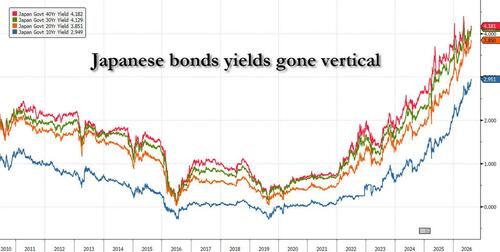
As Japanese Bond Yields Soar, Unrealized Losses At Life Insurers Hit $200 Billion
Bull/Bear Index 46.9/100
macro ▼ Bear Impact 72/100 ZeroHedge 2h ago Read original ↗

As Japanese Bond Yields Soar, Unrealized Losses At Life Insurers Hit $200 Billion

How this call is verified

The ▼ Bearish call is auto-verified against the actual S&P 500 price in ~22h.

Our record on calls like this

1,258 scored calls here, 46.4% right (±9.3pp). Always answering up would have scored 62.4% — so we are -16.0pp.

Bar: S&P 500 ±0.3% within 24h · every verdict lands on the public ledger

AI comment — why bearish

Rising Japanese government bond yields are forcing life insurers to confront roughly $200 billion of unrealized losses, a development that reverberates beyond the domestic insurance sector. The heightened liability pressure could tighten insurers’ capital buffers, prompting a sell‑off in equity holdings and increasing demand for high‑quality fixed‑income as firms seek liquidity. This dynamic dovetails with broader macro trends of tightening monetary policy in Japan, a strengthening yen, and a global shift toward steeper yield curves, all of which amplify concerns about balance‑sheet resilience across financial institutions. Market sentiment is likely to tilt more cautious, as investors reassess the risk of similar exposures in other jurisdictions. Consequently, confidence may erode modestly, nudging risk‑averse capital toward defensive assets and dampening appetite for higher‑yielding, higher‑volatility positions.

Key takeaway

"As Japanese Bond Yields Soar, Unrealized Losses At Life Insurers Hit $200 Billion" — BullBear's AI rates this story as a bearish (negative) signal for markets, with a market-impact score of 72 out of 100. Rising Japanese government bond yields are forcing life insurers to confront roughly $200 billion of unrealized losses, a development that reverberates beyond the domestic insurance sector. The heightened liability pressure could tighten insurers’ capital buffers, prompting a sell‑off in equity holdings and increasing demand for high‑quality fixed‑income as firms seek liquidity. This dynamic dovetails with broader macro trends of tightening monetary policy in Japan, a strengthening yen, and a global shift toward steeper yield curves, all of which amplify concerns about balance‑sheet resilience across financial institutions. Market sentiment is likely to tilt more cautious, as investors reassess the risk of similar exposures in other jurisdictions. Consequently, confidence may erode modestly, nudging risk‑averse capital toward defensive assets and dampening appetite for higher‑yielding, higher‑volatility positions. That score reflects how strongly the story is likely to move Bitcoin, US equities, the dollar, and gold, and near-duplicate coverage of the same event is clustered so only the representative article is scored. Reported by ZeroHedge on August 18, 2026. The call is verified against the actual 24-hour price move on BullBear's public conviction ledger.

Catch the next bear flag

Telegram alerts when our AI scores a story 80+/100 impact (~1-3 per day, no spam). Verified 30d hit rate 46.4%.

Join Telegram channel

📡 Tomorrow's Watch

Related news

▼ Bear
85/100
ZeroHedge 4h ago

Trump Threatens To 'Bomb The S**t' Out Of Oman & Touts IRGC Backchannel

Rewritten: Trump signals military action against Oman, mentions Iran talks.

Trump Doubles Down On Plans To Make Hormuz Strait A US Territory: "A Great Idea" Summary Trump repeats declaration that he'll make Strait of Hormuz a "US territory", calling it "a great idea". Iran goes "fully offensive": Tehran threatens escalation if diplomacy fails, after last week's military command reshuffle. MoU expires: Iran says the US-Iran agreement is effectively dead & "irrelevant".&nbsp; Trump threatens Oman: Trump warns "we'll bomb the s**t out of them." Backchannel denied: Tehran rejects Trump's claim of IRGC communications. <!--//--><![CDATA[// ><!-- <!--//--><![CDATA[// ><!-- <!--//--><![CDATA[// ><!-- { "@context": "https://schema.org", "@type": "WebPage", "name": "Strait of Hormuz traffic returns to normal by September 30?", "description": "Prediction market: Yes 12% · No 89% on Polymarket.", "url": "https://polymarket.com/event/strait-of-hormuz-traffic-returns-to-normal-by-september-30-20260702154339440", "publisher": { "@type": "Organization", "name": "Polymarket", "url": "https://polymarket.com" } }

Rising geopolitical tensions sparked by the former president's incendiary remarks about Oman and the highlighted Iran‑backed channel inject fresh uncertainty into global markets, particularly in energy and defense sectors. Heightened risk of disruption to Persian Gulf shipping lanes could tighten oil supplies, prompting a short‑term rally in crude prices while simultaneously prompting equity investors to rotate out of risk‑sensitive regions. The episode dovetails with broader macro concerns over supply‑chain fragility, inflationary pressure from higher energy costs, and the lingering specter of U.S. foreign‑policy volatility, reinforcing a cautious stance among central banks. Consequently, investor confidence may erode as risk appetite contracts, leading to broader sell‑offs in emerging‑market assets and a flight to safe‑haven currencies and Treasury yields. Market sentiment is likely to remain jittery until diplomatic signals clarify the likelihood of actual military escalation.

Rising geopolitical tensions sparked by the former president's incendiary remarks about Oman and the highlighted Iran‑backed channel inject fresh uncertainty into global markets, particularly in energy and defense sectors. Heightened risk of disruption to Persian Gulf shipping lanes could tighten oil supplies, prompting a short‑term rally in crude prices while simultaneously prompting equity investors to rotate out of risk‑sensitive regions. The episode dovetails with broader macro concerns over supply‑chain fragility, inflationary pressure from higher energy costs, and the lingering specter of U.S. foreign‑policy volatility, reinforcing a cautious stance among central banks. Consequently, investor confidence may erode as risk appetite contracts, leading to broader sell‑offs in emerging‑market assets and a flight to safe‑haven currencies and Treasury yields. Market sentiment is likely to remain jittery until diplomatic signals clarify the likelihood of actual military escalation.

#macro
▼ Bear
85/100
Wolf Street 10h ago

Foreign Central Banks & Governments Dumped Treasuries, Led by China/Hong Kong and Japan to Raise USD for Yen Intervention

Rewritten: China, Hong Kong, Japan sell Treasuries to fund USD for yen intervention

The coordinated off‑loading of U.S. Treasury securities by several sovereign investors, spearheaded by China/Hong Kong and Japan, signals a shift in the supply‑demand dynamics of the world’s benchmark bond market. By converting holdings into dollars to fund yen‑support operations, these authorities increase Treasury supply, pressuring yields higher and reinforcing the recent upward trend in long‑term rates. The move deepens concerns that fiscal and monetary policy divergences are widening, feeding a narrative of reduced confidence in the safety of U.S. sovereign debt and prompting a modest rotation toward higher‑yielding assets. Market sentiment turns more cautious as investors reassess liquidity buffers and the potential for further central‑bank interventions, dampening risk appetite for equities and emerging‑market exposure. Overall, the episode underscores macro‑level stress on the dollar‑treasury nexus and may erode investor confidence in the stability of the global funding framework.

The coordinated off‑loading of U.S. Treasury securities by several sovereign investors, spearheaded by China/Hong Kong and Japan, signals a shift in the supply‑demand dynamics of the world’s benchmark bond market. By converting holdings into dollars to fund yen‑support operations, these authorities increase Treasury supply, pressuring yields higher and reinforcing the recent upward trend in long‑term rates. The move deepens concerns that fiscal and monetary policy divergences are widening, feeding a narrative of reduced confidence in the safety of U.S. sovereign debt and prompting a modest rotation toward higher‑yielding assets. Market sentiment turns more cautious as investors reassess liquidity buffers and the potential for further central‑bank interventions, dampening risk appetite for equities and emerging‑market exposure. Overall, the episode underscores macro‑level stress on the dollar‑treasury nexus and may erode investor confidence in the stability of the global funding framework.

#macro
▼ Bear
70/100
ZeroHedge 10h ago

What's Behind Trump's Unexpected Favor To Kim Jong Un?

Rewritten: Reasons for Trump's surprising support of Kim Jong Un

Trump’s sudden overture toward Kim Jong Un injects fresh geopolitical uncertainty into an already volatile landscape, prompting traders to reassess risk premia across equities and commodities. The unexpected diplomatic gesture revives concerns over potential policy shifts that could destabilize sanctions regimes, nudging investors toward safe‑haven assets such as Treasury bonds and gold while dampening appetite for high‑beta stocks. This development dovetails with broader macro themes of rising protectionism and the fragility of supply‑chain realignments, reinforcing a narrative that geopolitical risk remains a dominant driver of market dynamics. Consequently, confidence among risk‑on participants wanes, and portfolio allocations may tilt toward defensive positions, heightening bearish pressure on growth‑oriented sectors and amplifying volatility in currency markets as traders price in the possibility of renewed diplomatic volatility.

Trump’s sudden overture toward Kim Jong Un injects fresh geopolitical uncertainty into an already volatile landscape, prompting traders to reassess risk premia across equities and commodities. The unexpected diplomatic gesture revives concerns over potential policy shifts that could destabilize sanctions regimes, nudging investors toward safe‑haven assets such as Treasury bonds and gold while dampening appetite for high‑beta stocks. This development dovetails with broader macro themes of rising protectionism and the fragility of supply‑chain realignments, reinforcing a narrative that geopolitical risk remains a dominant driver of market dynamics. Consequently, confidence among risk‑on participants wanes, and portfolio allocations may tilt toward defensive positions, heightening bearish pressure on growth‑oriented sectors and amplifying volatility in currency markets as traders price in the possibility of renewed diplomatic volatility.

#macro
▼ Bear
80/100
ZeroHedge 16h ago

Half Of Typical US Family's Paycheck Swallowed By Housing, Childcare

Rewritten: Housing and childcare consume half of US family income.

When a typical U.S. household allocates half of its paycheck to housing and childcare, disposable income shrinks, tightening consumer spending and pressuring earnings forecasts for retailers and services. The squeeze feeds into broader inflationary concerns, reinforcing expectations that the Federal Reserve may keep rates higher for longer, which in turn dampens equity valuations, especially for growth‑oriented sectors sensitive to borrowing costs. Investor sentiment is likely to turn more cautious as the data underscore structural cost pressures that could erode demand and delay a full‑scale recovery, feeding a risk‑off bias toward defensive assets. This development dovetails with macro themes of wage stagnation versus rising essential costs, highlighting the fragility of household balance sheets and potentially prompting a reassessment of risk appetite across portfolios, with a tilt away from discretionary and high‑beta exposures.

When a typical U.S. household allocates half of its paycheck to housing and childcare, disposable income shrinks, tightening consumer spending and pressuring earnings forecasts for retailers and services. The squeeze feeds into broader inflationary concerns, reinforcing expectations that the Federal Reserve may keep rates higher for longer, which in turn dampens equity valuations, especially for growth‑oriented sectors sensitive to borrowing costs. Investor sentiment is likely to turn more cautious as the data underscore structural cost pressures that could erode demand and delay a full‑scale recovery, feeding a risk‑off bias toward defensive assets. This development dovetails with macro themes of wage stagnation versus rising essential costs, highlighting the fragility of household balance sheets and potentially prompting a reassessment of risk appetite across portfolios, with a tilt away from discretionary and high‑beta exposures.

#macro
▼ Bear
75/100
ZeroHedge 17h ago

Geopolitical Reality Has Ended The Rush To Renewables

Rewritten: Geopolitical realities halt the surge toward renewable energy

With geopolitical tensions reshaping supply chains and tightening access to critical minerals, the anticipated acceleration toward renewable energy projects is losing momentum, reverberating across equity and commodity markets. Energy‑heavy indices are seeing a modest reallocation toward traditional oil and gas stocks, while green‑bond issuance faces heightened scrutiny, dampening the sector’s recent rally. The slowdown dovetails with broader macro concerns about inflationary pressure from higher fossil‑fuel prices and the uncertainty of policy support in volatile regions, reinforcing a risk‑off bias among investors. Consequently, confidence in long‑term clean‑tech bets is eroding, prompting a more cautious stance that favors assets perceived as less exposed to geopolitical disruption. This shift in risk appetite may compress valuations in the renewable space and elevate volatility as market participants reassess the timeline for the energy transition.

With geopolitical tensions reshaping supply chains and tightening access to critical minerals, the anticipated acceleration toward renewable energy projects is losing momentum, reverberating across equity and commodity markets. Energy‑heavy indices are seeing a modest reallocation toward traditional oil and gas stocks, while green‑bond issuance faces heightened scrutiny, dampening the sector’s recent rally. The slowdown dovetails with broader macro concerns about inflationary pressure from higher fossil‑fuel prices and the uncertainty of policy support in volatile regions, reinforcing a risk‑off bias among investors. Consequently, confidence in long‑term clean‑tech bets is eroding, prompting a more cautious stance that favors assets perceived as less exposed to geopolitical disruption. This shift in risk appetite may compress valuations in the renewable space and elevate volatility as market participants reassess the timeline for the energy transition.

#macro