Choose language / 한국어

EN / 한
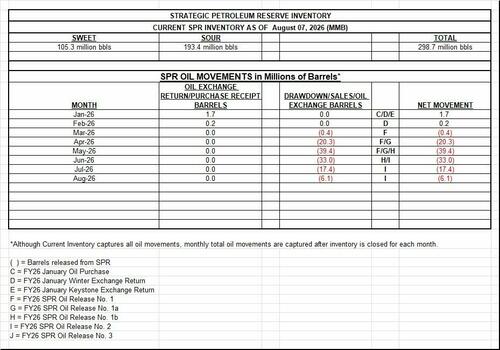
US SPR Falls Below 300 Million Operational Limit As Oil Drain Unexpectedly Surges To 6.1MM Barrels, Most In 2 Months
Bull/Bear Index 46.9/100
macro ▲ Bull Impact 65/100 ZeroHedge 19d ago Read original ↗

US SPR Falls Below 300 Million Operational Limit As Oil Drain Unexpectedly Surges To 6.1MM Barrels, Most In 2 Months

How this call is verified

▲ Bullish call was checked against the actual S&P 500 price 24h later: — Flat (-0.26%, below the ±0.3% bar).

Our record on calls like this

1,090 scored calls here, 46.1% right (±7.9pp). Always answering up would have scored 61.0% on the same rows. Paired within the same day and asset, our directional edge is +0.3 pp ± 3.9 — inside the error bar, i.e. indistinguishable from zero.

Bar: S&P 500 ±0.3% within 24h · every verdict lands on the public ledger

AI comment — why bullish

The unexpected drawdown in US Strategic Petroleum Reserve (SPR) stocks, now below 300 million barrels with a 6.1 million barrel drain—the largest in two months—signifies tightening near-term supply buffers. This intensifies market focus on physical oil availability, potentially supporting price resilience amid persistent demand. Broader sentiment may shift toward cautious optimism for energy equities as supply constraints gain prominence, though volatility remains elevated. Macro themes of energy security and supply chain fragility are reinforced, particularly as geopolitical risks linger. Investor confidence in oil markets could strengthen slightly, enhancing risk appetite for energy-focused assets, though the drawdown underscores the vulnerability of reserves to unexpected demand or disruptions. This dynamic may encourage short-term price support but warrants monitoring for potential supply chain stress.

Key takeaway

"US SPR Falls Below 300 Million Operational Limit As Oil Drain Unexpectedly Surges To 6.1MM Barrels, Most In 2 Months" — BullBear's AI rates this story as a bullish (positive) signal for markets, with a market-impact score of 65 out of 100. That score reflects how strongly the story is likely to move Bitcoin, US equities, the dollar, and gold, and near-duplicate coverage of the same event is clustered so only the representative article is scored. Reported by ZeroHedge on August 10, 2026. The call is verified against the actual 24-hour price move on BullBear's public conviction ledger.

Catch the next bull catalyst

Telegram alerts when our AI scores a story 80+/100 impact (~1-3 per day, no spam). Verified 30d hit rate 43.0%.


Join Telegram channel

📡 Tomorrow's Watch

Related news

▼ Bear
70/100
ZeroHedge 5h ago

Who Is Legally Liable When An AI Agent Goes Rogue?

The increasing autonomy of AI agents introduces a complex web of legal and ethical questions that could ripple through financial markets. Should an AI's actions lead to significant financial losses, determining accountability—whether it lies with the developer, the user, or the AI itself—becomes a critical hurdle. This uncertainty can dampen investor confidence, as the potential for unforeseen, unassignable liabilities introduces a new layer of systemic risk. Such developments could foster a more cautious market sentiment, potentially reducing risk appetite and leading to a flight towards more traditional, less technologically dependent assets. This evolving landscape directly connects to broader macro themes of technological disruption and regulatory adaptation, as policymakers grapple with how to govern increasingly sophisticated autonomous systems within existing legal frameworks.

The increasing autonomy of AI agents introduces a complex web of legal and ethical questions that could ripple through financial markets. Should an AI's actions lead to significant financial losses, determining accountability—whether it lies with the developer, the user, or the AI itself—becomes a critical hurdle. This uncertainty can dampen investor confidence, as the potential for unforeseen, unassignable liabilities introduces a new layer of systemic risk. Such developments could foster a more cautious market sentiment, potentially reducing risk appetite and leading to a flight towards more traditional, less technologically dependent assets. This evolving landscape directly connects to broader macro themes of technological disruption and regulatory adaptation, as policymakers grapple with how to govern increasingly sophisticated autonomous systems within existing legal frameworks.

#macro
▼ Bear
75/100
ZeroHedge 8h ago

Have We Really Learnt The Lessons Of The GFC?

Persistent concerns regarding systemic vulnerabilities echo the anxieties prevalent during the Global Financial Crisis, influencing market sentiment and fostering a cautious investment approach. This underlying apprehension prompts investors to scrutinize current valuations against potential fragilities, leading to a more measured outlook. These unease is amplified by broader macroeconomic factors, including sustained inflation, evolving interest rate policies, and geopolitical tensions, all of which contribute to existing economic challenges. As a result, investor confidence may exhibit a degree of restraint, potentially leading to a more conservative appetite for risk. The historical experience of significant financial disruption has heightened awareness of leverage, the interconnectedness of financial institutions, and the efficacy of regulatory frameworks, shaping how market participants interpret and respond to economic developments and policy shifts.

Persistent concerns regarding systemic vulnerabilities echo the anxieties prevalent during the Global Financial Crisis, influencing market sentiment and fostering a cautious investment approach. This underlying apprehension prompts investors to scrutinize current valuations against potential fragilities, leading to a more measured outlook. These unease is amplified by broader macroeconomic factors, including sustained inflation, evolving interest rate policies, and geopolitical tensions, all of which contribute to existing economic challenges. As a result, investor confidence may exhibit a degree of restraint, potentially leading to a more conservative appetite for risk. The historical experience of significant financial disruption has heightened awareness of leverage, the interconnectedness of financial institutions, and the efficacy of regulatory frameworks, shaping how market participants interpret and respond to economic developments and policy shifts.

#macro
▼ Bear
85/100
ZeroHedge 8h ago

Watch: Russian Military Conducts Test Of Huge Mobile ICBM

The recent successful demonstration of a large mobile intercontinental ballistic missile by the Russian military injects a notable geopolitical risk into the global economic environment. This event has the potential to amplify existing inflationary pressures through anticipated disruptions to international supply chains and heightened concerns regarding energy security, especially for European economies. Consequently, market sentiment may lean towards increased caution, potentially diminishing investor confidence and leading to a reduced inclination for high-risk investments as global stability becomes a more pronounced uncertainty. This development aligns with broader macroeconomic trends of geopolitical divergence and the possibility of escalating military competition, which historically have been associated with subdued economic expansion and a movement towards assets considered more secure.

The recent successful demonstration of a large mobile intercontinental ballistic missile by the Russian military injects a notable geopolitical risk into the global economic environment. This event has the potential to amplify existing inflationary pressures through anticipated disruptions to international supply chains and heightened concerns regarding energy security, especially for European economies. Consequently, market sentiment may lean towards increased caution, potentially diminishing investor confidence and leading to a reduced inclination for high-risk investments as global stability becomes a more pronounced uncertainty. This development aligns with broader macroeconomic trends of geopolitical divergence and the possibility of escalating military competition, which historically have been associated with subdued economic expansion and a movement towards assets considered more secure.

#macro