Choose language / Korean

EN / 한
Wall Street: Less Fed information will mean more volatile markets - Axios
Bull/Bear Index 46.6/100
macro ▼ Bear Impact 85/100 Google News Macroecon... 21d ago Read original ↗

Wall Street: Less Fed information will mean more volatile markets - Axios

How this call is verified

▼ Bearish call was checked against the actual S&P 500 price 24h later: ✗ Miss (+1.79%).

Our record on calls like this

1,286 scored calls here, 46.7% right (±9.1pp). Always answering up would have scored 61.9% — so we are -15.2pp.

Bar: S&P 500 ±0.3% within 24h · every verdict lands on the public ledger

AI comment — why bearish

A reduction in public statements from the central bank suggests a potential for heightened market volatility. This diminished flow of information could exacerbate existing uncertainties, contributing to a more cautious investor disposition. With less explicit guidance on the trajectory of monetary policy, market participants may observe amplified price fluctuations and a greater reaction to incoming economic indicators. The influence of broader macroeconomic trends, such as the persistence of inflation and the outlook for economic expansion, may become more significant in the absence of clear central bank commentary. This scenario could lead to a decrease in investor confidence and a reduced inclination for risk-taking as individuals may prioritize more stable investment conditions. Consequently, the market environment might become more conducive to short-term trading strategies rather than extended investment plans.

Key takeaway

"Wall Street: Less Fed information will mean more volatile markets - Axios" — BullBear's AI rates this story as a bearish (negative) signal for markets, with a market-impact score of 85 out of 100. A reduction in public statements from the central bank suggests a potential for heightened market volatility. This diminished flow of information could exacerbate existing uncertainties, contributing to a more cautious investor disposition. With less explicit guidance on the trajectory of monetary policy, market participants may observe amplified price fluctuations and a greater reaction to incoming economic indicators. The influence of broader macroeconomic trends, such as the persistence of inflation and the outlook for economic expansion, may become more significant in the absence of clear central bank commentary. This scenario could lead to a decrease in investor confidence and a reduced inclination for risk-taking as individuals may prioritize more stable investment conditions. Consequently, the market environment might become more conducive to short-term trading strategies rather than extended investment plans. That score reflects how strongly the story is likely to move Bitcoin, US equities, the dollar, and gold, and near-duplicate coverage of the same event is clustered so only the representative article is scored. Reported by Google News Macroeconomics (EN) on August 04, 2026. The call is verified against the actual 24-hour price move on BullBear's public conviction ledger.

Catch the next bear flag

Telegram alerts when our AI scores a story 80+/100 impact (~1-3 per day, no spam). Verified 30d hit rate 42.4%.


Join Telegram channel

📡 Tomorrow's Watch

Related news

▲ Bull
80/100
ZeroHedge 2h ago

Trump Says All Mines Cleared From Strait Of Hormuz, Warns Military Options Still On Table

Rewritten: Trump: Mines cleared from Hormuz Strait, military options remain possible

By asserting that all mines have been cleared from the Strait of Hormuz, the administration reduces a key geopolitical risk that has historically pressured oil prices and heightened global supply‑chain uncertainty. The removal of an immediate threat to one of the world’s most vital shipping lanes can ease commodity‑market volatility, supporting a steadier energy price outlook and encouraging capital flows into risk‑on assets such as equities and high‑yield bonds. At the same time, the reminder that military options remain on the table keeps a modest caution in investors’ minds, reinforcing the importance of diversified positioning. This development dovetails with broader macro themes of de‑escalation in Middle‑East tensions and a gradual shift toward monetary‑policy normalization, bolstering confidence in sustained growth trajectories and nudging risk appetite upward without eliminating all geopolitical concerns.

By asserting that all mines have been cleared from the Strait of Hormuz, the administration reduces a key geopolitical risk that has historically pressured oil prices and heightened global supply‑chain uncertainty. The removal of an immediate threat to one of the world’s most vital shipping lanes can ease commodity‑market volatility, supporting a steadier energy price outlook and encouraging capital flows into risk‑on assets such as equities and high‑yield bonds. At the same time, the reminder that military options remain on the table keeps a modest caution in investors’ minds, reinforcing the importance of diversified positioning. This development dovetails with broader macro themes of de‑escalation in Middle‑East tensions and a gradual shift toward monetary‑policy normalization, bolstering confidence in sustained growth trajectories and nudging risk appetite upward without eliminating all geopolitical concerns.

#macro
▲ Bull
70/100
ZeroHedge 3h ago

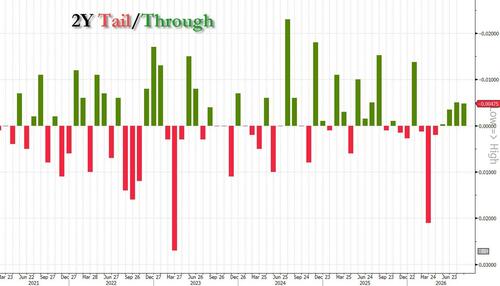
Stellar 2Y Auction Stops Through On Most Foreign Buying Since March 2025

Rewritten: Stellar 2-year auction ends with highest foreign buying since March 2025

Strong foreign buying in the latest 2‑year Treasury auction, the highest since March 2025, signals a shift toward short‑duration safety amid lingering uncertainty over monetary policy trajectories. By absorbing the entire issue, overseas investors are effectively endorsing the perception that near‑term rate expectations remain elevated, which could dampen demand for longer‑dated securities and reinforce a flattening yield curve. This activity bolsters market sentiment by providing liquidity to a segment that often serves as a barometer for risk appetite, suggesting that investors are willing to park capital in low‑duration assets while awaiting clearer guidance on inflation and fiscal deficits. The episode dovetails with broader macro themes of cautious optimism, as central banks worldwide balance tightening cycles against growth concerns, and it may enhance confidence among risk‑averse participants, albeit without dramatically altering overall market risk‑on dynamics.

Strong foreign buying in the latest 2‑year Treasury auction, the highest since March 2025, signals a shift toward short‑duration safety amid lingering uncertainty over monetary policy trajectories. By absorbing the entire issue, overseas investors are effectively endorsing the perception that near‑term rate expectations remain elevated, which could dampen demand for longer‑dated securities and reinforce a flattening yield curve. This activity bolsters market sentiment by providing liquidity to a segment that often serves as a barometer for risk appetite, suggesting that investors are willing to park capital in low‑duration assets while awaiting clearer guidance on inflation and fiscal deficits. The episode dovetails with broader macro themes of cautious optimism, as central banks worldwide balance tightening cycles against growth concerns, and it may enhance confidence among risk‑averse participants, albeit without dramatically altering overall market risk‑on dynamics.

#macro
▼ Bear
68/100
ZeroHedge 4h ago

Canada Retaliates, Slaps $20 Billion In Tariffs On 700 US Goods

Rewritten: Canada imposes $20 billion tariffs on 700 U.S. products in retaliation

Canada's decision to impose roughly $20 billion in tariffs on 700 U.S. products escalates trade friction at a time when global growth outlook remains fragile, prompting investors to reassess exposure to North American equities. The move reinforces protectionist narratives that have already weighed on risk‑off sentiment, potentially dampening demand for U.S. exporters and compressing profit margins in sectors reliant on cross‑border supply chains. By heightening geopolitical uncertainty, the tariff wave dovetails with broader macro concerns such as lingering supply‑chain disruptions, divergent monetary policy cycles, and the prospect of slower earnings growth. Consequently, confidence in the resilience of the U.S. market may erode, nudging capital toward defensive assets and reducing appetite for higher‑beta positions, while prompting portfolio managers to scrutinize trade‑sensitive holdings for heightened volatility. The heightened tariff environment could also pressure the Canadian dollar, while reinforcing a modest dollar rally as investors seek safe‑haven assets.

Canada's decision to impose roughly $20 billion in tariffs on 700 U.S. products escalates trade friction at a time when global growth outlook remains fragile, prompting investors to reassess exposure to North American equities. The move reinforces protectionist narratives that have already weighed on risk‑off sentiment, potentially dampening demand for U.S. exporters and compressing profit margins in sectors reliant on cross‑border supply chains. By heightening geopolitical uncertainty, the tariff wave dovetails with broader macro concerns such as lingering supply‑chain disruptions, divergent monetary policy cycles, and the prospect of slower earnings growth. Consequently, confidence in the resilience of the U.S. market may erode, nudging capital toward defensive assets and reducing appetite for higher‑beta positions, while prompting portfolio managers to scrutinize trade‑sensitive holdings for heightened volatility. The heightened tariff environment could also pressure the Canadian dollar, while reinforcing a modest dollar rally as investors seek safe‑haven assets.

#macro
▼ Bear
70/100
ZeroHedge 5h ago

Trump Admin Proposes New $100K H-1B Fee To Offset Immigration Enforcement Costs

Rewritten: Trump administration proposes $100,000 H‑1B fee to cover enforcement costs

By raising the H‑1B fee to $100,000, the administration signals a willingness to use immigration policy as a revenue source, which could increase operating costs for tech firms and other employers reliant on skilled foreign labor. Higher expenses may compress profit margins, prompting analysts to downgrade earnings forecasts and weigh down equity valuations, particularly in the Nasdaq‑heavy sectors. The move dovetails with broader protectionist trends and fiscal tightening, reinforcing concerns about a less accommodative policy environment and adding to the narrative of rising structural headwinds for growth‑oriented companies. Investor confidence may erode as uncertainty over talent pipelines and cost structures intensifies, leading risk‑averse capital to shift toward defensive assets. Consequently, risk appetite could wane, supporting a modest pullback in high‑beta stocks and bolstering demand for safe‑haven instruments.

By raising the H‑1B fee to $100,000, the administration signals a willingness to use immigration policy as a revenue source, which could increase operating costs for tech firms and other employers reliant on skilled foreign labor. Higher expenses may compress profit margins, prompting analysts to downgrade earnings forecasts and weigh down equity valuations, particularly in the Nasdaq‑heavy sectors. The move dovetails with broader protectionist trends and fiscal tightening, reinforcing concerns about a less accommodative policy environment and adding to the narrative of rising structural headwinds for growth‑oriented companies. Investor confidence may erode as uncertainty over talent pipelines and cost structures intensifies, leading risk‑averse capital to shift toward defensive assets. Consequently, risk appetite could wane, supporting a modest pullback in high‑beta stocks and bolstering demand for safe‑haven instruments.

#macro