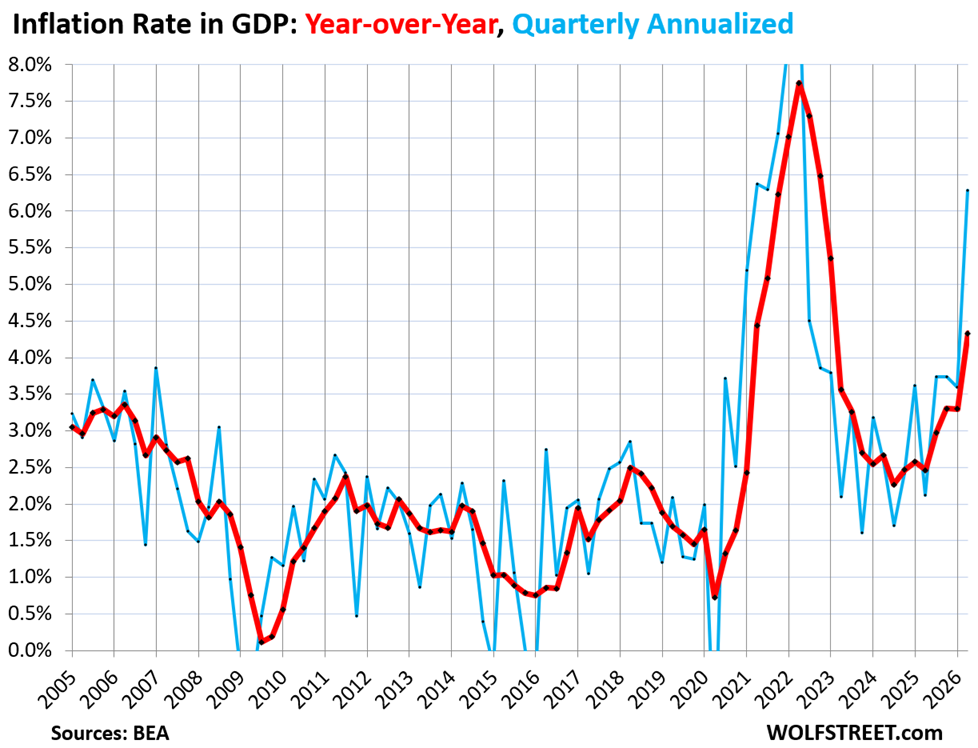
Inflation in the Overall Economy, Hitting Consumers, Businesses, and Governments, Was Really Bad in Q2, even without Energy
How this call is verified
▼ Bearish call was checked against the actual S&P 500 price 24h later: ✗ Miss (+0.70%).
Our record on calls like this
1,128 scored calls here, 46.7% right (±7.7pp). Always answering up would have scored 60.4% on the same rows. Paired within the same day and asset, our directional edge is +1.9 pp ± 4.3 — inside the error bar, i.e. indistinguishable from zero.
Bar: S&P 500 ±0.3% within 24h · every verdict lands on the public ledger
AI comment — why bearish
The sustained inflationary pressures evident in the second quarter, even when accounting for the exclusion of energy prices, point to a complex economic environment with broad market ramifications. This persistent rise in the cost of goods and services diminishes the real value of consumer income, thereby potentially curtailing discretionary spending. Simultaneously, businesses face increased input costs, which can compress profitability and necessitate adjustments to pricing strategies or operational efficiencies. This scenario often contributes to a more subdued market sentiment, as economic actors adopt a more conservative approach. The ongoing inflation underscores the resilience of underlying economic challenges, such as supply chain inefficiencies and labor cost dynamics, suggesting these factors are not temporary. As a result, investor sentiment may become more risk-averse, leading to a potential reallocation of capital away from speculative investments and towards more stable assets, which could manifest as heightened market fluctuations and a greater emphasis on defensive portfolio allocations.
Key takeaway
"Inflation in the Overall Economy, Hitting Consumers, Businesses, and Governments, Was Really Bad in Q2, even without Energy" — BullBear's AI rates this story as a bearish (negative) signal for markets, with a market-impact score of 90 out of 100. That score reflects how strongly the story is likely to move Bitcoin, US equities, the dollar, and gold, and near-duplicate coverage of the same event is clustered so only the representative article is scored. Reported by Wolf Street on July 31, 2026. The call is verified against the actual 24-hour price move on BullBear's public conviction ledger.
Catch the next bear flag
Telegram alerts when our AI scores a story 80+/100 impact (~1-3 per day, no spam). Verified 30d hit rate 45.2%.