Choose language / Korean

EN / 한
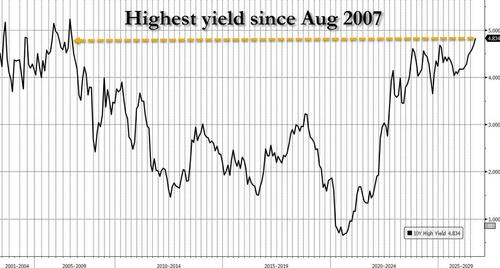
US borrowing costs hit 19-year high as Fed defies inflation fears
Bull/Bear Index 42.5/100
macro ▼ Bear Impact 90/100 Google News Macroecon... 1h ago Read original ↗

US borrowing costs hit 19-year high as Fed defies inflation fears

US borrowing costs hit 19-year high as Fed defies inflation fears

How this call is verified

The ▼ Bearish call is auto-verified against the actual S&P 500 price in ~23h.

Bar: S&P 500 ±0.3% within 24h · every verdict lands on the public ledger

AI comment — why bearish

The recent ascent of United States borrowing costs to a level not seen in nineteen years indicates a sustained commitment by the Federal Reserve to combat inflationary pressures. This prolonged period of elevated interest rates may exert downward pressure on overall market valuations, as the increased cost of capital influences corporate profitability and investor expectations. Such a monetary policy environment can foster a more risk-averse sentiment, leading market participants to scrutinize the relationship between the cost of financing and the anticipated returns on investment. The prevailing macroeconomic narrative of monetary tightening and the imperative to control rising prices could consequently lead to a reassessment of risk tolerance. This shift may manifest as a decline in investor confidence and a potential rotation towards assets perceived as more secure, alongside a decrease in speculative trading activities amidst heightened economic uncertainty.

Key takeaway

"US borrowing costs hit 19-year high as Fed defies inflation fears" — BullBear's AI rates this story as a bearish (negative) signal for markets, with a market-impact score of 90 out of 100. US borrowing costs hit 19-year high as Fed defies inflation fears The recent ascent of United States borrowing costs to a level not seen in nineteen years indicates a sustained commitment by the Federal Reserve to combat inflationary pressures. This prolonged period of elevated interest rates may exert downward pressure on overall market valuations, as the increased cost of capital influences corporate profitability and investor expectations. Such a monetary policy environment can foster a more risk-averse sentiment, leading market participants to scrutinize the relationship between the cost of financing and the anticipated returns on investment. The prevailing macroeconomic narrative of monetary tightening and the imperative to control rising prices could consequently lead to a reassessment of risk tolerance. This shift may manifest as a decline in investor confidence and a potential rotation towards assets perceived as more secure, alongside a decrease in speculative trading activities amidst heightened economic uncertainty. That score reflects how strongly the story is likely to move Bitcoin, US equities, the dollar, and gold, and near-duplicate coverage of the same event is clustered so only the representative article is scored. Reported by Google News Macroeconomics (EN) on July 29, 2026. The call is verified against the actual 24-hour price move on BullBear's public conviction ledger.

Catch the next bear flag

Telegram alerts when our AI scores a story 80+/100 impact (~1-3 per day, no spam). Verified 30d hit rate 51.3%.

Join Telegram channel

📡 Tomorrow's Watch

Related news

▼ Bear
85/100
Google News Macroeconomics (EN) 50m ago

US Fed holds interest rates steady citing ‘elevated’ inflation

Rewritten: Fed keeps rates unchanged due to persistent inflation.

The US Federal Reserve has decided to keep interest rates unchanged, citing that inflation remains at elevated levels.

The Federal Reserve's recent decision to hold benchmark interest rates at their current levels, coupled with its acknowledgment of elevated inflation, indicates a deliberate and measured approach to monetary policy. This holding pattern, while intended to combat inflationary pressures, may introduce a period of market uncertainty. Investors could become more hesitant, considering the implications of sustained higher borrowing costs on corporate profitability and consumer spending. The persistent focus on inflation suggests that underlying economic factors, such as ongoing supply chain disruptions and a tight labor market, continue to exert influence. This environment may lead to a reassessment of investment strategies, with a potential shift towards more conservative asset allocations as market participants navigate the evolving economic landscape and the delayed timeline for potential interest rate reductions.

The Federal Reserve's recent decision to hold benchmark interest rates at their current levels, coupled with its acknowledgment of elevated inflation, indicates a deliberate and measured approach to monetary policy. This holding pattern, while intended to combat inflationary pressures, may introduce a period of market uncertainty. Investors could become more hesitant, considering the implications of sustained higher borrowing costs on corporate profitability and consumer spending. The persistent focus on inflation suggests that underlying economic factors, such as ongoing supply chain disruptions and a tight labor market, continue to exert influence. This environment may lead to a reassessment of investment strategies, with a potential shift towards more conservative asset allocations as market participants navigate the evolving economic landscape and the delayed timeline for potential interest rate reductions.

#macro
▲ Bull
60/100
Google News Macroeconomics (EN) 57m ago

Trump stands by his 'brilliant' Fed pick despite no rate cuts

Rewritten: Trump backs Fed nominee, no rate cuts expected.

Trump stands by his 'brilliant' Fed pick despite no rate cuts

Former President Trump's continued endorsement of Jerome Powell, despite the Federal Reserve's current stance against immediate rate cuts, signals a potential divergence in economic policy expectations. This unwavering support, even in the face of differing monetary strategies, could be interpreted by the market as a commitment to a particular economic philosophy, potentially influencing future regulatory approaches and fiscal stimulus discussions. For investors, this dynamic may foster a degree of uncertainty regarding the Fed's long-term direction, subtly impacting risk appetite as they weigh the implications of a potentially more interventionist economic agenda against current monetary tightening. The broader market implications hinge on how this perceived policy divergence interacts with ongoing inflation concerns and global economic growth narratives, creating a complex backdrop for investment decisions.

Former President Trump's continued endorsement of Jerome Powell, despite the Federal Reserve's current stance against immediate rate cuts, signals a potential divergence in economic policy expectations. This unwavering support, even in the face of differing monetary strategies, could be interpreted by the market as a commitment to a particular economic philosophy, potentially influencing future regulatory approaches and fiscal stimulus discussions. For investors, this dynamic may foster a degree of uncertainty regarding the Fed's long-term direction, subtly impacting risk appetite as they weigh the implications of a potentially more interventionist economic agenda against current monetary tightening. The broader market implications hinge on how this perceived policy divergence interacts with ongoing inflation concerns and global economic growth narratives, creating a complex backdrop for investment decisions.

#macro
▲ Bull
80/100
Google News Macroeconomics (EN) 1h ago

Gold price jumps as Federal Reserve leaves interest rates unchanged

Rewritten: Gold rises as Fed holds interest rates steady.

Gold price jumps as Federal Reserve leaves interest rates unchanged

The Federal Reserve's decision to maintain current interest rates has injected a renewed sense of optimism into the precious metals market, with gold experiencing a notable uptick. This development suggests a potential pause in the tightening cycle, which can alleviate pressure on non-yielding assets like gold by making them relatively more attractive compared to fixed-income investments. The immediate impact on market sentiment appears to be a shift towards a more cautious, yet hopeful, outlook, as investors digest the implications of sustained monetary policy. This aligns with broader macroeconomic themes of moderating inflation and a desire for stability in an uncertain economic landscape. Consequently, investor confidence may see a subtle boost, potentially leading to a measured increase in risk appetite as the perceived downside from aggressive rate hikes diminishes, though caution will likely remain a dominant theme.

The Federal Reserve's decision to maintain current interest rates has injected a renewed sense of optimism into the precious metals market, with gold experiencing a notable uptick. This development suggests a potential pause in the tightening cycle, which can alleviate pressure on non-yielding assets like gold by making them relatively more attractive compared to fixed-income investments. The immediate impact on market sentiment appears to be a shift towards a more cautious, yet hopeful, outlook, as investors digest the implications of sustained monetary policy. This aligns with broader macroeconomic themes of moderating inflation and a desire for stability in an uncertain economic landscape. Consequently, investor confidence may see a subtle boost, potentially leading to a measured increase in risk appetite as the perceived downside from aggressive rate hikes diminishes, though caution will likely remain a dominant theme.

#macro
▼ Bear
📡 +12 95/100
Google News Macroeconomics (EN) 1h ago

Federal Reserve votes 9-3 to leave key rate unchanged despite persistently high inflation

Rewritten: Fed holds rates steady 9-3 amid persistent inflation.

Federal Reserve votes 9-3 to leave key rate unchanged despite persistently high inflation

The Federal Reserve's recent vote to hold the federal funds rate steady, even in the face of persistent inflation, suggests a measured stance that could extend current economic uncertainties. This development may dampen optimistic market outlooks, as stakeholders consider the implications of sustained higher borrowing costs on corporate profitability and asset valuations. The divergence between the central bank's monetary policy and the ongoing inflationary environment underscores a significant macroeconomic challenge: the delicate act of achieving price stability without unduly hindering economic expansion. As a result, investor sentiment might experience a muted response, potentially fostering a more cautious market atmosphere as participants reassess their investment strategies amidst the prospect of prolonged elevated interest rates.

The Federal Reserve's recent vote to hold the federal funds rate steady, even in the face of persistent inflation, suggests a measured stance that could extend current economic uncertainties. This development may dampen optimistic market outlooks, as stakeholders consider the implications of sustained higher borrowing costs on corporate profitability and asset valuations. The divergence between the central bank's monetary policy and the ongoing inflationary environment underscores a significant macroeconomic challenge: the delicate act of achieving price stability without unduly hindering economic expansion. As a result, investor sentiment might experience a muted response, potentially fostering a more cautious market atmosphere as participants reassess their investment strategies amidst the prospect of prolonged elevated interest rates.

#macro