Choose language / Korean

EN / 한
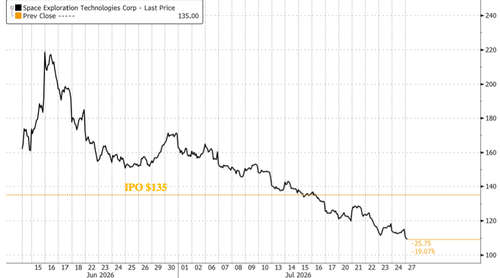
Mapping SpaceX's Lockup Expirations: HSBC Calculates When The Shares Could Hit The Market
Bull/Bear Index 48.2/100
macro ▼ Bear Impact 65/100 ZeroHedge 20d ago Read original ↗

Mapping SpaceX's Lockup Expirations: HSBC Calculates When The Shares Could Hit The Market

How this call is verified

▼ Bearish call was checked against the actual S&P 500 price 24h later: — Flat (+0.12%, below the ±0.3% bar).

Our record on calls like this

1,253 scored calls here, 46.3% right (±9.3pp). Always answering up would have scored 62.6% — so we are -16.3pp.

Bar: S&P 500 ±0.3% within 24h · every verdict lands on the public ledger

AI comment — why bearish

Analysis suggests that a significant volume of SpaceX shares may become available for trading following scheduled lockup expirations. This potential increase in supply could exert downward pressure on valuations within the aerospace and technology industries, as well as for companies with similar growth profiles. The timing of these expirations is a key factor, potentially introducing a period of market uncertainty and influencing investor sentiment. This situation is occurring against a backdrop of ongoing discussions regarding capital allocation strategies and the valuation methodologies applied to privately held, high-growth entities. The prospect of a substantial share release may necessitate a recalibration of risk assessments by investors and could contribute to increased market volatility. Consequently, portfolio managers are likely factoring this potential supply event into their strategic planning and asset allocation decisions within the prevailing economic environment.

Key takeaway

"Mapping SpaceX's Lockup Expirations: HSBC Calculates When The Shares Could Hit The Market" — BullBear's AI rates this story as a bearish (negative) signal for markets, with a market-impact score of 65 out of 100. Analysis suggests that a significant volume of SpaceX shares may become available for trading following scheduled lockup expirations. This potential increase in supply could exert downward pressure on valuations within the aerospace and technology industries, as well as for companies with similar growth profiles. The timing of these expirations is a key factor, potentially introducing a period of market uncertainty and influencing investor sentiment. This situation is occurring against a backdrop of ongoing discussions regarding capital allocation strategies and the valuation methodologies applied to privately held, high-growth entities. The prospect of a substantial share release may necessitate a recalibration of risk assessments by investors and could contribute to increased market volatility. Consequently, portfolio managers are likely factoring this potential supply event into their strategic planning and asset allocation decisions within the prevailing economic environment. That score reflects how strongly the story is likely to move Bitcoin, US equities, the dollar, and gold, and near-duplicate coverage of the same event is clustered so only the representative article is scored. Reported by ZeroHedge on July 27, 2026. The call is verified against the actual 24-hour price move on BullBear's public conviction ledger.

Catch the next bear flag

Telegram alerts when our AI scores a story 80+/100 impact (~1-3 per day, no spam). Verified 30d hit rate 46.2%.

Join Telegram channel

📡 Tomorrow's Watch

Related news

▼ Bear
75/100
ZeroHedge 2h ago

U.S. Drafts Ultimatum for Allies Joining China's AI Bloc

Rewritten: US Warns Allies Against Joining China's AI Group

The emergence of a U.S. proposal that could necessitate allies making definitive choices about engagement with China's artificial intelligence development introduces considerable geopolitical uncertainty into the global economic environment. This situation carries the potential to fragment the technology industry, compelling businesses to align with specific geopolitical blocs. Consequently, this could lead to the bifurcation of critical supply chains and collaborative research efforts. Such a scenario is likely to negatively impact market sentiment, amplifying existing uncertainties and potentially prompting a reallocation of capital towards assets perceived as more stable. This development is intrinsically linked to broader macroeconomic trends, including the ongoing trend of technological decoupling and the sustained strategic competition between leading global economies. Investor confidence may experience a decline as the outlook shifts towards a more fragmented and less predictable international marketplace, which could, in turn, impede sustained growth trajectories and elevate fluctuations within stock markets, particularly those concentrated in technology.

The emergence of a U.S. proposal that could necessitate allies making definitive choices about engagement with China's artificial intelligence development introduces considerable geopolitical uncertainty into the global economic environment. This situation carries the potential to fragment the technology industry, compelling businesses to align with specific geopolitical blocs. Consequently, this could lead to the bifurcation of critical supply chains and collaborative research efforts. Such a scenario is likely to negatively impact market sentiment, amplifying existing uncertainties and potentially prompting a reallocation of capital towards assets perceived as more stable. This development is intrinsically linked to broader macroeconomic trends, including the ongoing trend of technological decoupling and the sustained strategic competition between leading global economies. Investor confidence may experience a decline as the outlook shifts towards a more fragmented and less predictable international marketplace, which could, in turn, impede sustained growth trajectories and elevate fluctuations within stock markets, particularly those concentrated in technology.

#macro
▲ Bull
70/100
ZeroHedge 7h ago

Fog Of War: A World Searching For An Exit

Rewritten: War's Fog: Humanity Seeking a Way Out

Amid escalating geopolitical tensions and lingering supply-chain disruptions, markets are beginning to price in a gradual de‑escalation as policymakers coordinate exit strategies, fostering a subtle shift toward optimism. The prospect of coordinated fiscal and monetary easing, coupled with improving commodity price dynamics, underpins a broader narrative that risk assets may regain momentum after a prolonged defensive posture. Investor sentiment, still cautious after recent volatility, is buoyed by signals of stabilized inflation and a tentative rebound in consumer confidence, encouraging a modest reallocation toward equities and high‑yield credit. This alignment with macro themes of resilient growth and disciplined monetary policy reinforces confidence in the underlying economic trajectory, nudging risk appetite upward while preserving a measured approach to positioning. Consequently, the market’s collective outlook tilts bullish, reflecting an emerging belief that the fog of uncertainty is beginning to lift.

Amid escalating geopolitical tensions and lingering supply-chain disruptions, markets are beginning to price in a gradual de‑escalation as policymakers coordinate exit strategies, fostering a subtle shift toward optimism. The prospect of coordinated fiscal and monetary easing, coupled with improving commodity price dynamics, underpins a broader narrative that risk assets may regain momentum after a prolonged defensive posture. Investor sentiment, still cautious after recent volatility, is buoyed by signals of stabilized inflation and a tentative rebound in consumer confidence, encouraging a modest reallocation toward equities and high‑yield credit. This alignment with macro themes of resilient growth and disciplined monetary policy reinforces confidence in the underlying economic trajectory, nudging risk appetite upward while preserving a measured approach to positioning. Consequently, the market’s collective outlook tilts bullish, reflecting an emerging belief that the fog of uncertainty is beginning to lift.

#macro