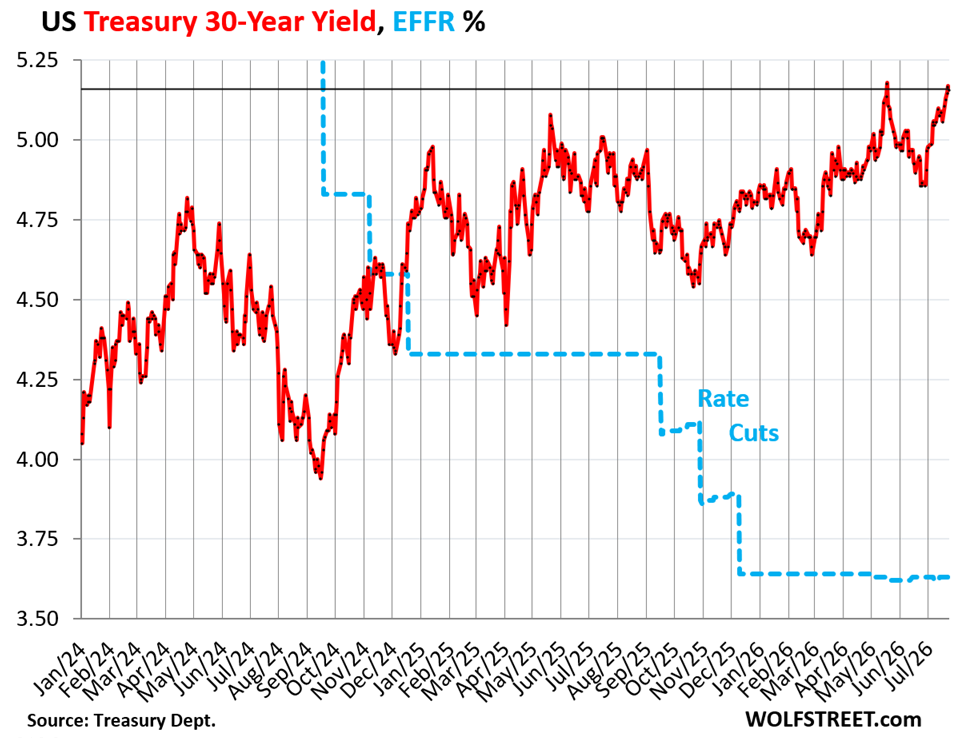
Long-Term Treasury Yields Jump as Bloodied Bond Market Gets Edgier about Inflation & the Massive New Debt
How this call is verified
▼ Bearish call was checked against the actual S&P 500 price 24h later: — Flat (+0.00%, below the ±0.3% bar).
Our record on calls like this
1,129 scored calls here, 46.8% right (±7.7pp). Always answering up would have scored 60.3% on the same rows. Paired within the same day and asset, our directional edge is +1.9 pp ± 4.3 — inside the error bar, i.e. indistinguishable from zero.
Bar: S&P 500 ±0.3% within 24h · every verdict lands on the public ledger
AI comment — why bearish
The surge in long-term Treasury yields signals a recalibration within fixed income markets, suggesting investors are demanding higher compensation for holding government debt amidst renewed inflation concerns and the substantial increase in new debt issuance. This shift could ripple through broader equity markets, potentially pressuring growth stocks that are more sensitive to rising interest rates and increasing the cost of capital for businesses. Market sentiment may turn more cautious as the prospect of sustained higher borrowing costs becomes more entrenched, impacting corporate earnings forecasts and valuations. This development directly connects to macro themes of fiscal sustainability and the Federal Reserve's ongoing battle against inflation, potentially leading to a more risk-averse environment. Consequently, investor confidence could wane, leading to a reduced appetite for speculative assets and a preference for more defensive allocations as the economic outlook becomes less certain.
Key takeaway
"Long-Term Treasury Yields Jump as Bloodied Bond Market Gets Edgier about Inflation & the Massive New Debt" — BullBear's AI rates this story as a bearish (negative) signal for markets, with a market-impact score of 85 out of 100. That score reflects how strongly the story is likely to move Bitcoin, US equities, the dollar, and gold, and near-duplicate coverage of the same event is clustered so only the representative article is scored. Reported by Wolf Street on July 25, 2026. The call is verified against the actual 24-hour price move on BullBear's public conviction ledger.
1 more report on this event
Catch the next bear flag
Telegram alerts when our AI scores a story 80+/100 impact (~1-3 per day, no spam). Verified 30d hit rate 45.5%.