Choose language / Korean

EN / 한
A Hidden Fed Disconnect Could Become the Market's Biggest Risk - Benzinga
Bull/Bear Index 47.9/100
macro ▼ Bear Impact 80/100 Google News Macroecon... 20d ago Read original ↗

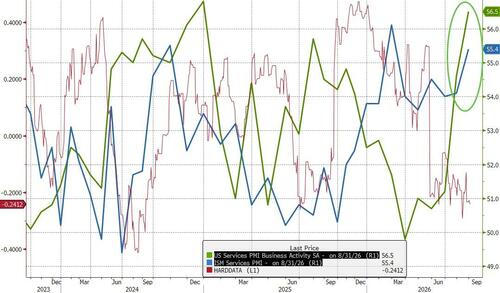
A Hidden Fed Disconnect Could Become the Market's Biggest Risk - Benzinga

How this call is verified

▼ Bearish call was checked against the actual S&P 500 price 24h later: — Flat (-0.11%, below the ±0.3% bar).

Our record on calls like this

1,240 scored calls here, 46.4% right (±9.4pp). Always answering up would have scored 62.3% — so we are -15.9pp.

Bar: S&P 500 ±0.3% within 24h · every verdict lands on the public ledger

AI comment — why bearish

A notable discrepancy between the Federal Reserve's stated policy intentions and observable economic trends presents a potential source of market instability. Should the central bank persist with restrictive monetary policy language even as inflation moderates and economic growth shows signs of deceleration, market participants may recalibrate their expectations for future rate adjustments. This reassessment could precipitate broad-based asset price declines as investors digest the implications of a potentially misaligned policy path. Such a situation risks undermining market confidence, as investors struggle to reconcile the Fed's pronouncements with the prevailing economic landscape. This uncertainty could exacerbate existing worries about economic contraction and the viability of current asset valuations, ultimately diminishing investor optimism and their willingness to assume risk. The market's subsequent behavior would likely be contingent on the speed and clarity with which the Federal Reserve adapts its stance to align with incoming economic data.

Key takeaway

"A Hidden Fed Disconnect Could Become the Market's Biggest Risk - Benzinga" — BullBear's AI rates this story as a bearish (negative) signal for markets, with a market-impact score of 80 out of 100. A notable discrepancy between the Federal Reserve's stated policy intentions and observable economic trends presents a potential source of market instability. Should the central bank persist with restrictive monetary policy language even as inflation moderates and economic growth shows signs of deceleration, market participants may recalibrate their expectations for future rate adjustments. This reassessment could precipitate broad-based asset price declines as investors digest the implications of a potentially misaligned policy path. Such a situation risks undermining market confidence, as investors struggle to reconcile the Fed's pronouncements with the prevailing economic landscape. This uncertainty could exacerbate existing worries about economic contraction and the viability of current asset valuations, ultimately diminishing investor optimism and their willingness to assume risk. The market's subsequent behavior would likely be contingent on the speed and clarity with which the Federal Reserve adapts its stance to align with incoming economic data. That score reflects how strongly the story is likely to move Bitcoin, US equities, the dollar, and gold, and near-duplicate coverage of the same event is clustered so only the representative article is scored. Reported by Google News Macroeconomics (EN) on July 21, 2026. The call is verified against the actual 24-hour price move on BullBear's public conviction ledger.

Catch the next bear flag

Telegram alerts when our AI scores a story 80+/100 impact (~1-3 per day, no spam). Verified 30d hit rate 49.1%.

Join Telegram channel

📡 Tomorrow's Watch

Related news

▼ Bear
65/100
Wolf Street 19m ago

Buy Low, Sell High: Intel Boosts its Massive Sale of Shares

Rewritten: Intel increases share sales

Intel's accelerated share sale underscores persistent weakness in the tech sector, potentially amplifying broader market concerns about overvalued growth stocks. This move signals management's urgency to bolster balance sheets amid challenging macro conditions, likely reinforcing risk-off sentiment as investors question capital allocation priorities. The timing coincides with elevated interest rates, making high-growth tech valuations increasingly vulnerable and shifting focus toward defensive sectors. Such large-scale equity offerings often erode investor confidence in a company's near-term prospects, dampening risk appetite across the technology space. The action reflects deeper structural pressures within the sector, where sustained profitability challenges and competitive headwinds are prompting defensive financial strategies. This could trigger wider profit-taking in tech, particularly among smaller-cap names, as market participants reassess growth narratives in the current rate-sensitive environment. (142 words)

Intel's accelerated share sale underscores persistent weakness in the tech sector, potentially amplifying broader market concerns about overvalued growth stocks. This move signals management's urgency to bolster balance sheets amid challenging macro conditions, likely reinforcing risk-off sentiment as investors question capital allocation priorities. The timing coincides with elevated interest rates, making high-growth tech valuations increasingly vulnerable and shifting focus toward defensive sectors. Such large-scale equity offerings often erode investor confidence in a company's near-term prospects, dampening risk appetite across the technology space. The action reflects deeper structural pressures within the sector, where sustained profitability challenges and competitive headwinds are prompting defensive financial strategies. This could trigger wider profit-taking in tech, particularly among smaller-cap names, as market participants reassess growth narratives in the current rate-sensitive environment. (142 words)

#macro