Choose language / Korean

Domino's US Sale Growth Hits Five-Quarter Low As Budget Diners Pull Back
Bull/Bear Index 47.4/100
macro ▼ Bear Impact 70/100 ZeroHedge 7h ago Read original ↗

Domino's US Sale Growth Hits Five-Quarter Low As Budget Diners Pull Back

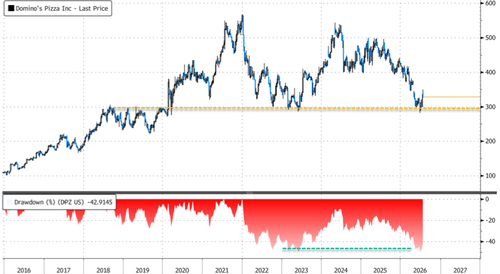
Domino's Pizza reported its slowest US comparable-sales growth in five quarters, as inflation and high gasoline prices are pressuring budget-conscious consumers to cut back on spending.

AI Insight

Slowing same-store sales growth at a major fast-food chain like Domino's US suggests a broader consumer pullback on discretionary spending, particularly among budget-conscious demographics. This trend could indicate weakening consumer sentiment as inflation continues to pressure household budgets, forcing a prioritization of essential goods over dining out. Such a slowdown in a widely accessible consumer staple may signal a more significant economic deceleration, potentially impacting market sentiment by raising concerns about corporate earnings across the consumer discretionary sector. Investor confidence could be tested, leading to a reduced risk appetite as the market digests the implications of consumers trading down or cutting back, even on value-oriented options. This aligns with macro themes of persistent inflation and potential interest rate headwinds impacting consumer behavior.

Key takeaway

"Domino's US Sale Growth Hits Five-Quarter Low As Budget Diners Pull Back" — BullBear's AI rates this story as a bearish (negative) signal for markets, with a market-impact score of 70 out of 100. Domino's Pizza reported its slowest US comparable-sales growth in five quarters, as inflation and high gasoline prices are pressuring budget-conscious consumers to cut back on spending. Slowing same-store sales growth at a major fast-food chain like Domino's US suggests a broader consumer pullback on discretionary spending, particularly among budget-conscious demographics. This trend could indicate weakening consumer sentiment as inflation continues to pressure household budgets, forcing a prioritization of essential goods over dining out. Such a slowdown in a widely accessible consumer staple may signal a more significant economic deceleration, potentially impacting market sentiment by raising concerns about corporate earnings across the consumer discretionary sector. Investor confidence could be tested, leading to a reduced risk appetite as the market digests the implications of consumers trading down or cutting back, even on value-oriented options. This aligns with macro themes of persistent inflation and potential interest rate headwinds impacting consumer behavior. That score reflects how strongly the story is likely to move Bitcoin, US equities, the dollar, and gold, and near-duplicate coverage of the same event is clustered so only the representative article is scored. Reported by ZeroHedge on July 21, 2026. The call is verified against the actual 24-hour price move on BullBear's public conviction ledger.

Catch the next bear flag

Telegram alerts when our AI scores a story 80+/100 impact (~1-3 per day, no spam). Verified 30d hit rate 52.2%.

Join Telegram channel

📡 Tomorrow's Watch

Related news

▼ Bear
70/100
Google News Macroeconomics (EN) 2h ago

Tech Stocks Were an Attractive Hedge Against Inflation. That May Be Changing.

Rewritten: Tech stocks' inflation hedge may be weakening.

Tech stocks, once considered an attractive hedge against inflation, may be losing that status.

The diminishing effectiveness of technology equities as a safeguard against inflationary pressures could precipitate a broader market adjustment. Should these growth-focused entities struggle to consistently outperform escalating costs, a re-evaluation of equity valuations across various sectors may ensue. This potential recalibration could temper general market optimism, as a significant contributor to recent performance experiences headwinds. Such a scenario aligns with prevailing macroeconomic concerns regarding interest rate increases and the sustained effort to control inflation, indicating a potentially more demanding landscape for assets perceived as higher risk. Consequently, investor sentiment might experience erosion, fostering a diminished inclination for risk-taking and possibly prompting a reallocation of capital towards more defensive industries or investment categories in pursuit of capital preservation.

The diminishing effectiveness of technology equities as a safeguard against inflationary pressures could precipitate a broader market adjustment. Should these growth-focused entities struggle to consistently outperform escalating costs, a re-evaluation of equity valuations across various sectors may ensue. This potential recalibration could temper general market optimism, as a significant contributor to recent performance experiences headwinds. Such a scenario aligns with prevailing macroeconomic concerns regarding interest rate increases and the sustained effort to control inflation, indicating a potentially more demanding landscape for assets perceived as higher risk. Consequently, investor sentiment might experience erosion, fostering a diminished inclination for risk-taking and possibly prompting a reallocation of capital towards more defensive industries or investment categories in pursuit of capital preservation.

#macro
▼ Bear
80/100
Google News Macroeconomics (EN) 2h ago

Warsh's First Test: Fed Chair Faces Inflation Scrutiny - Legis1

Rewritten: Here are a few options, keeping the meaning and constraints: * Fed

Fed Chair faces scrutiny over inflation. - Legis1

Jerome Powell's upcoming testimony, dubbed "Warsh's First Test," places the Federal Reserve Chair under intense scrutiny regarding persistent inflation. This situation carries significant implications for broader market movements, potentially triggering increased volatility as investors digest the Fed's latest assessment and forward guidance. Market sentiment is likely to lean cautious, with a heightened focus on any signals of a more hawkish stance or a prolonged period of elevated interest rates. This directly connects to macro themes of stagflationary pressures and the ongoing debate surrounding the Fed's ability to engineer a soft landing. Consequently, investor confidence could waver, leading to a reduced risk appetite and a potential rotation away from growth-oriented assets towards more defensive sectors as uncertainty surrounding the inflation outlook and monetary policy trajectory intensifies.

Jerome Powell's upcoming testimony, dubbed "Warsh's First Test," places the Federal Reserve Chair under intense scrutiny regarding persistent inflation. This situation carries significant implications for broader market movements, potentially triggering increased volatility as investors digest the Fed's latest assessment and forward guidance. Market sentiment is likely to lean cautious, with a heightened focus on any signals of a more hawkish stance or a prolonged period of elevated interest rates. This directly connects to macro themes of stagflationary pressures and the ongoing debate surrounding the Fed's ability to engineer a soft landing. Consequently, investor confidence could waver, leading to a reduced risk appetite and a potential rotation away from growth-oriented assets towards more defensive sectors as uncertainty surrounding the inflation outlook and monetary policy trajectory intensifies.

#macro