Choose language / Korean

EN / 한
PayPal Soars On Reported $53 Billion Buyout Bid From Stripe And Advent
Bull/Bear Index 48.2/100
macro ▲ Bull Impact 80/100 ZeroHedge 20d ago Read original ↗

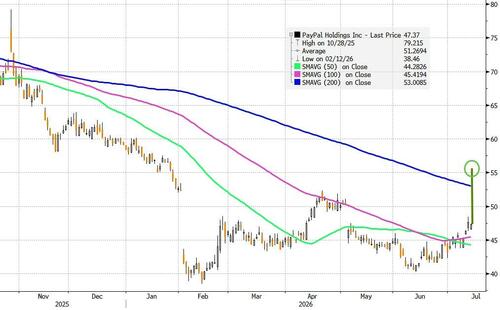
PayPal Soars On Reported $53 Billion Buyout Bid From Stripe And Advent

PayPal shares surge on a report of a $53 billion buyout bid from Stripe and Advent International.

How this call is verified

▲ Bullish call was checked against the actual S&P 500 price 24h later: ✓ Hit (+0.38%).

Bar: S&P 500 ±0.3% within 24h · every verdict lands on the public ledger

Key takeaway

"PayPal Soars On Reported $53 Billion Buyout Bid From Stripe And Advent" — BullBear's AI rates this story as a bullish (positive) signal for markets, with a market-impact score of 80 out of 100. PayPal shares surge on a report of a $53 billion buyout bid from Stripe and Advent International. Reported by ZeroHedge on July 15, 2026. The call is verified against the actual 24-hour price move on BullBear's public conviction ledger.

Catch the next bull catalyst

Telegram alerts when our AI scores a story 80+/100 impact (~1-3 per day, no spam). Verified 30d hit rate 48.1%.

Join Telegram channel

📡 Tomorrow's Watch

Related news

▼ Bear
80/100
Google News Macroeconomics (EN) 1h ago

Trump Fed chair’s inflation strategy: leave it to the market - The Guardian

Rewritten: Trump's Fed Chair: Market-Driven Inflation Solution

A former Trump nominee for Fed chair suggested an inflation strategy that relies on market forces rather than direct central bank intervention.

Recent economic policy discussions suggest a potential shift in approach to managing inflation, leaning towards a more hands-off market-driven strategy. This perspective posits that by allowing market forces to operate with minimal intervention, the natural mechanisms of supply and demand will ultimately self-correct inflationary pressures. The underlying assumption is that the market possesses an inherent ability to find equilibrium, and that attempts to actively steer inflation through direct policy interventions may prove less effective or even counterproductive. This approach contrasts with more interventionist strategies that employ direct monetary or fiscal tools to influence price levels. The effectiveness and potential consequences of such a market-centric approach are subjects of ongoing analysis and debate among economists and policymakers.

Recent economic policy discussions suggest a potential shift in approach to managing inflation, leaning towards a more hands-off market-driven strategy. This perspective posits that by allowing market forces to operate with minimal intervention, the natural mechanisms of supply and demand will ultimately self-correct inflationary pressures. The underlying assumption is that the market possesses an inherent ability to find equilibrium, and that attempts to actively steer inflation through direct policy interventions may prove less effective or even counterproductive. This approach contrasts with more interventionist strategies that employ direct monetary or fiscal tools to influence price levels. The effectiveness and potential consequences of such a market-centric approach are subjects of ongoing analysis and debate among economists and policymakers.

#macro
▼ Bear
90/100
Google News Macroeconomics (EN) 1h ago

So what’s the plan to bring down inflation? The new Fed chair and his White House allies say you shouldn’t ask. - MarketWatch

Rewritten: Fed chair, allies deflect inflation plan questions.

The new Fed chair and White House allies are discouraging questions about the plan to reduce inflation, suggesting a lack of transparency.

The current economic climate is characterized by a divergence between official communication and market anticipation concerning inflation mitigation. This perceived lack of transparency regarding a concrete strategy could introduce significant uncertainty, potentially amplifying volatility across various investment vehicles as market participants attempt to interpret the prevailing economic trajectory. Such ambiguity may also contribute to a general softening of market sentiment, as the absence of a clearly articulated plan can undermine confidence in the effectiveness of implemented monetary policies. This environment could lend credence to macroeconomic concerns such as stagflation or extended periods of economic stagnation, particularly if inflationary pressures prove resilient without a discernible resolution pathway. Ultimately, this situation may lead to a decline in investor confidence, a reduced inclination for risk-taking, and a subsequent pivot towards more conservative investment strategies in anticipation of a potentially more difficult economic landscape.

The current economic climate is characterized by a divergence between official communication and market anticipation concerning inflation mitigation. This perceived lack of transparency regarding a concrete strategy could introduce significant uncertainty, potentially amplifying volatility across various investment vehicles as market participants attempt to interpret the prevailing economic trajectory. Such ambiguity may also contribute to a general softening of market sentiment, as the absence of a clearly articulated plan can undermine confidence in the effectiveness of implemented monetary policies. This environment could lend credence to macroeconomic concerns such as stagflation or extended periods of economic stagnation, particularly if inflationary pressures prove resilient without a discernible resolution pathway. Ultimately, this situation may lead to a decline in investor confidence, a reduced inclination for risk-taking, and a subsequent pivot towards more conservative investment strategies in anticipation of a potentially more difficult economic landscape.

#macro
60/100
Google News Macroeconomics (EN) 1h ago

Monetary Policy Perspective: Keeping an Open Mind - Philadelphia Federal Reserve Bank

The Philadelphia Federal Reserve Bank emphasizes a data-dependent and cautious approach to monetary policy, stating they will keep rates high until confident that inflation is returning to target. However, maintaining an 'open mind' without specifying a clear timeline for rate cuts introduces uncertainty into the market.

#macro
▼ Bear
80/100
Google News Macroeconomics (EN) 2h ago

Why the Fed’s Published Inflation Forecasts Are Meaningless—Or Worse - Council on Foreign Relations

Rewritten: Fed inflation forecasts lack reliable predictive value.

This article from the Council on Foreign Relations argues that the Fed's published inflation forecasts are meaningless or worse, raising questions about the effectiveness of monetary policy.

The analysis raises questions about the efficacy of official inflation projections, suggesting a potential divergence from actual economic outcomes. This discrepancy, if perceived by market participants, could foster an environment of heightened uncertainty, potentially leading to increased price fluctuations. Such a situation might challenge the expectation of a smooth disinflationary process, thereby amplifying concerns about the persistence of inflationary pressures and their downstream effects on asset values. Consequently, a reduction in investor willingness to take on risk could manifest, possibly prompting a rebalancing of portfolios towards less volatile assets. This scenario underscores the ongoing challenge of managing a complex inflationary landscape and places a spotlight on the perceived reliability of central bank communications.

The analysis raises questions about the efficacy of official inflation projections, suggesting a potential divergence from actual economic outcomes. This discrepancy, if perceived by market participants, could foster an environment of heightened uncertainty, potentially leading to increased price fluctuations. Such a situation might challenge the expectation of a smooth disinflationary process, thereby amplifying concerns about the persistence of inflationary pressures and their downstream effects on asset values. Consequently, a reduction in investor willingness to take on risk could manifest, possibly prompting a rebalancing of portfolios towards less volatile assets. This scenario underscores the ongoing challenge of managing a complex inflationary landscape and places a spotlight on the perceived reliability of central bank communications.

#macro
▼ Bear
75/100
ZeroHedge 2h ago

World's Largest PC Makers Start Using Memory Chips From China's CXMT

Rewritten: Top PC makers adopt Chinese CXMT memory chips.

Major PC manufacturers like HP, Asus, and Acer have begun using memory chips from China's CXMT amidst a severe memory shortage. This move diversifies supply chains but could increase competition for established memory chip giants like Samsung, SK Hynix, and Micron.

The adoption of memory chips from China's CXMT by leading personal computer manufacturers indicates a significant evolution in global technology supply chains. This integration suggests a potential increase in market competition and downward pressure on pricing for memory components, which could affect the financial performance of incumbent suppliers. The development may also contribute to a more cautious investor sentiment, driven by concerns regarding geopolitical tensions and the resilience of established supply networks. This trend reflects broader global discussions around technological self-sufficiency and the growing influence of Chinese semiconductor manufacturers. As a result, market participants may adjust their outlook on companies heavily dependent on current memory chip providers, potentially leading to a more measured approach to risk as the competitive environment and its impact on revenue and market positioning are evaluated.

The adoption of memory chips from China's CXMT by leading personal computer manufacturers indicates a significant evolution in global technology supply chains. This integration suggests a potential increase in market competition and downward pressure on pricing for memory components, which could affect the financial performance of incumbent suppliers. The development may also contribute to a more cautious investor sentiment, driven by concerns regarding geopolitical tensions and the resilience of established supply networks. This trend reflects broader global discussions around technological self-sufficiency and the growing influence of Chinese semiconductor manufacturers. As a result, market participants may adjust their outlook on companies heavily dependent on current memory chip providers, potentially leading to a more measured approach to risk as the competitive environment and its impact on revenue and market positioning are evaluated.

#macro