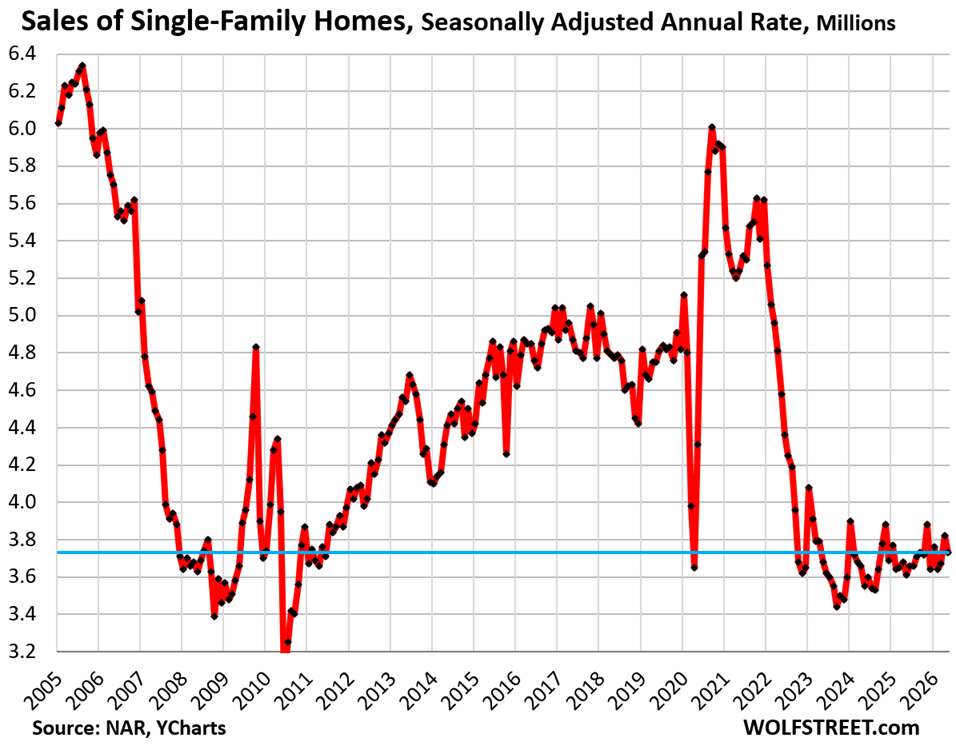
Supply of Existing Single-Family Homes Jumps to 10-Year High, Condo Supply to 14-Year High. Sales Slip Deeper into Deep Freeze. Mortgage Rates Rise to 6.49%
How this call is verified
▼ Bearish
call was checked against the actual S&P 500 price 24h later:
✗ Miss (+0.33%).
Our record on calls like this
1,274 scored calls here,
46.8% right (±9.2pp).
Always answering up would have scored 61.9% —
so we are
-15.1pp.
Bar: S&P 500 ±0.3% within 24h · every verdict lands on the public ledger
Key takeaway
"Supply of Existing Single-Family Homes Jumps to 10-Year High, Condo Supply to 14-Year High. Sales Slip Deeper into Deep Freeze. Mortgage Rates Rise to 6.49%" — BullBear's AI rates this story as a bearish (negative) signal for markets, with a market-impact score of 75 out of 100. Reported by Wolf Street on July 09, 2026. The call is verified against the actual 24-hour price move on BullBear's public conviction ledger.
Catch the next bear flag
Telegram alerts when our AI scores a story 80+/100 impact (~1-3 per day, no spam).
Verified 30d hit rate 44.3%.
Rewritten: Europe seeks innovation and defense amid US global shift.
A discernible shift in geopolitical alignment, characterized by the United States recalibrating its engagement with established international frameworks, is prompting a strategic pivot across European economies. This recalibration necessitates a heightened focus on domestic innovation and defense capabilities, potentially redirecting capital and resources away from traditional global investment flows. Such a realignment could foster a more fragmented market environment, impacting global trade dynamics and supply chain resilience. Market sentiment may become more cautious as investors assess the evolving risk landscape, with a potential dampening effect on risk appetite as uncertainties surrounding future international cooperation persist. This development connects to broader macro themes of deglobalization and the rise of regional economic blocs, influencing investor confidence by highlighting the need for greater self-reliance and potentially increasing the perceived risk of international portfolio diversification.