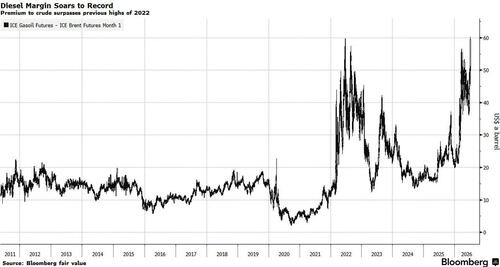
Russia Bans Diesel Exports, Assuring Even Higher Prices
Russia banned exports of diesel in order to avoid domestic shortages after a flurry of attacks by Ukrainian drones on the nation’s refineries.
How this call is verified
▼ Bearish
call was checked against the actual S&P 500 price 24h later:
✗ Miss (+0.85%).
Bar: S&P 500 ±0.3% within 24h · every verdict lands on the public ledger
Key takeaway
"Russia Bans Diesel Exports, Assuring Even Higher Prices" — BullBear's AI rates this story as a bearish (negative) signal for markets, with a market-impact score of 80 out of 100. Russia banned exports of diesel in order to avoid domestic shortages after a flurry of attacks by Ukrainian drones on the nation’s refineries. Reported by ZeroHedge on July 08, 2026. The call is verified against the actual 24-hour price move on BullBear's public conviction ledger.
Catch the next bear flag
Telegram alerts when our AI scores a story 80+/100 impact (~1-3 per day, no spam).
Verified 30d hit rate 50.9%.
Federal Reserve: Extended pause guidance – UOB FXStreet
The Federal Reserve's signaling of a prolonged pause in its interest rate hiking cycle suggests a shift in the monetary policy landscape, with potential ramifications across financial markets. This extended period of stable rates could encourage a more circumspect market outlook, prompting investors to reassess their projections for economic expansion and inflationary pressures. The implications align with prevailing macroeconomic narratives, especially regarding the persistent efforts to control inflation and the possibility of sustained higher borrowing costs. Such guidance might lead to a moderation in investor optimism, potentially diminishing the appeal of speculative investments due to the continued elevated cost of capital. As a result, market attention may increasingly gravitate towards sectors perceived as more resilient and towards businesses exhibiting robust financial health, as participants adapt to this phase of sustained monetary policy.
Rewritten: Inflation data may lessen Fed rate hike pressure.
Inflation gauge reboot to ease pressure on Federal Reserve to raise interest rates Financial Times
A revised approach to measuring inflation, as reported, may influence the Federal Reserve's decisions regarding interest rate adjustments. This recalibration could potentially reduce the impetus for further rate hikes, which in turn might create a more supportive backdrop for equity markets. Investor sentiment could see an uplift, anticipating a less stringent monetary policy. This development aligns with prevailing macroeconomic narratives of decelerating inflation and a possible shift away from aggressive monetary tightening. Such an environment could enhance investor confidence, potentially leading to increased allocation towards riskier assets as the perceived risk of prolonged elevated borrowing costs subsides. Consequently, market attention may pivot towards investments focused on economic expansion and industries that typically perform well in periods of stable or declining interest rates.
Rewritten: Fed rate decision due amid rising gas prices.
The Federal Reserve is set to issue its interest rate decision amidst rising gas prices.
The Federal Reserve's upcoming interest rate decision is anticipated to be closely scrutinized by market participants, particularly in light of recent upward pressure on energy prices. Fluctuations in the cost of gasoline can contribute to broader inflationary trends, potentially influencing the central bank's monetary policy considerations. Analysts are observing whether these price dynamics will necessitate a more hawkish stance from the Fed, which could translate to higher borrowing costs across the economy. Conversely, the Fed may weigh the impact of such a move on economic growth against the need to manage inflation. The market's reaction will likely depend on the precise language and forward guidance provided by the Fed, as investors attempt to decipher the path of future monetary policy.
Rewritten: Warsh's Fed faces inflation test amid affordability crisis.
Fed chair Kevin Warsh faces a key test as inflation compounds the affordability crisis.
The Federal Reserve's approach to persistent inflation, particularly as it exacerbates the cost of living for consumers, presents a significant challenge for Chair Kevin Warsh. Should the Fed's policy response prove insufficient or overly aggressive, broader market implications could include increased volatility across asset classes as investors reassess growth prospects and discount rates. Market sentiment may shift towards caution, with a heightened focus on defensive sectors and a potential reduction in risk appetite. This situation directly connects to macro themes of stagflationary pressures and the efficacy of monetary policy in a complex economic environment. Investor confidence could erode if the perceived ability of the central bank to manage inflation and support economic stability is questioned, leading to a more risk-averse stance in portfolio allocations.
Rewritten: Fed rate hikes may clash with Trump's agenda.
The Federal Reserve appears to be on a collision course with former President Trump as interest rate hikes loom on the horizon.
The prospect of the Federal Reserve implementing interest rate increases, juxtaposed with the economic policy pronouncements of a prominent political figure, suggests an environment characterized by elevated market apprehension. This potential divergence in economic strategy could cultivate a more risk-averse market disposition, as participants assess the consequences of restrictive monetary measures alongside possible fiscal stimulus or alterations in international trade agreements. The overarching economic narrative centers on the balance between curbing inflationary pressures and fostering economic expansion, creating a dynamic that may influence market trajectories. Such a scenario could lead to a decline in investor optimism, prompting a diminished tolerance for risk and a potential shift towards assets considered more secure. The interaction between monetary policy decisions and political commentary establishes a multifaceted context for investment decisions and strategic considerations.
#macro
Get the next 80+ impact catalyst
Push notifications when our AI flags a high-impact bull/bear story. ~1–3 per day.