Choose language / Korean

EN / 한
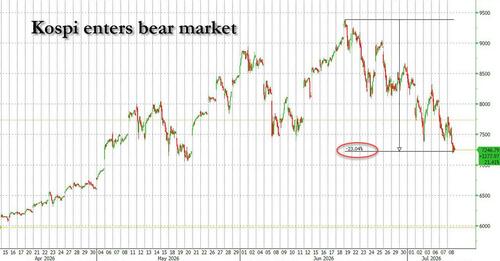
South Korea Falls Into Bear Market As Memory Euphoria Fizzles
Bull/Bear Index 43.1/100
macro ▼ Bear Impact 65/100 ZeroHedge 20d ago Read original ↗

South Korea Falls Into Bear Market As Memory Euphoria Fizzles

South Korea's Kospi index has officially entered a technical bear market as investor concerns grow over the long-term prospects of AI chipmakers that previously drove a significant rally. The initial euphoria in major tech stocks like Samsung Electronics and SK Hynix has reversed, leading to a sharp decline.

How this call is verified

▼ Bearish call was checked against the actual S&P 500 price 24h later: ✗ Miss (+0.57%).

Bar: S&P 500 ±0.3% within 24h · every verdict lands on the public ledger

Key takeaway

"South Korea Falls Into Bear Market As Memory Euphoria Fizzles" — BullBear's AI rates this story as a bearish (negative) signal for markets, with a market-impact score of 65 out of 100. South Korea's Kospi index has officially entered a technical bear market as investor concerns grow over the long-term prospects of AI chipmakers that previously drove a significant rally. The initial euphoria in major tech stocks like Samsung Electronics and SK Hynix has reversed, leading to a sharp decline. Reported by ZeroHedge on July 08, 2026. The call is verified against the actual 24-hour price move on BullBear's public conviction ledger.

Catch the next bear flag

Telegram alerts when our AI scores a story 80+/100 impact (~1-3 per day, no spam). Verified 30d hit rate 51.2%.

Join Telegram channel

📡 Tomorrow's Watch

Related news

▼ Bear
75/100
Google News Macroeconomics (EN) 34m ago

U.S. dollar slips 0.10 percent to 101.165 as markets price 30 percent chance of Fed hike

Rewritten: Dollar falls slightly as Fed hike odds reach 30 percent.

The U.S. dollar slipped 0.10 percent to 101.165 as markets priced in a 30 percent chance of a Federal Reserve hike.

The recent decline in the dollar's value indicates a market adjustment in anticipation of Federal Reserve monetary policy. This recalibration suggests that participants are factoring in a reduced probability of further interest rate increases, potentially signaling a pause or even a shift in the central bank's approach. Such a development could influence market sentiment by fostering expectations of a less restrictive interest rate environment. This aligns with prevailing macroeconomic discussions around moderating inflation and a potential deceleration in economic expansion, prompting a re-evaluation of asset valuations. Consequently, investor confidence may experience a moderate uplift, potentially leading to a slightly more favorable risk appetite as the perceived likelihood of elevated borrowing costs decreases. This could translate into increased interest in riskier asset classes and a general upward trend in market activity, although the exact trajectory of future Fed actions remains a key consideration for market participants.

The recent decline in the dollar's value indicates a market adjustment in anticipation of Federal Reserve monetary policy. This recalibration suggests that participants are factoring in a reduced probability of further interest rate increases, potentially signaling a pause or even a shift in the central bank's approach. Such a development could influence market sentiment by fostering expectations of a less restrictive interest rate environment. This aligns with prevailing macroeconomic discussions around moderating inflation and a potential deceleration in economic expansion, prompting a re-evaluation of asset valuations. Consequently, investor confidence may experience a moderate uplift, potentially leading to a slightly more favorable risk appetite as the perceived likelihood of elevated borrowing costs decreases. This could translate into increased interest in riskier asset classes and a general upward trend in market activity, although the exact trajectory of future Fed actions remains a key consideration for market participants.

#macro
▼ Bear
85/100
Google News Macroeconomics (EN) 51m ago

The Federal Reserve Should Raise Interest Rates Today, but It Won't for One Fundamental Reason - The Motley Fool

Rewritten: Fed likely to hold rates due to core economic reason.

The Federal Reserve Should Raise Interest Rates Today, but It Won't for One Fundamental Reason The Motley Fool

The Federal Reserve's recent decision to maintain its current interest rate policy, despite indications of economic pressures, suggests a deliberate and measured approach to monetary management. This stance, likely influenced by a complex interplay of underlying economic factors, may contribute to a degree of investor uncertainty, potentially leading to a more subdued appetite for risk assets. The divergence between observable economic signals and immediate policy adjustments underscores the intricate nature of the current macroeconomic environment. Consequently, the central bank's future communications and forward guidance are likely to be closely scrutinized by market participants seeking clarity on its long-term strategic direction. This period of observation could result in increased market volatility as investors attempt to interpret the potential ramifications for economic expansion and inflationary trends, possibly prompting a review of investment strategies and a shift towards more conservative portfolio allocations.

The Federal Reserve's recent decision to maintain its current interest rate policy, despite indications of economic pressures, suggests a deliberate and measured approach to monetary management. This stance, likely influenced by a complex interplay of underlying economic factors, may contribute to a degree of investor uncertainty, potentially leading to a more subdued appetite for risk assets. The divergence between observable economic signals and immediate policy adjustments underscores the intricate nature of the current macroeconomic environment. Consequently, the central bank's future communications and forward guidance are likely to be closely scrutinized by market participants seeking clarity on its long-term strategic direction. This period of observation could result in increased market volatility as investors attempt to interpret the potential ramifications for economic expansion and inflationary trends, possibly prompting a review of investment strategies and a shift towards more conservative portfolio allocations.

#macro
▼ Bear
80/100
Google News Macroeconomics (EN) 1h ago

Treasury yields inch higher as Wall Street awaits Fed interest rate decision - CNBC

Rewritten: Treasury yields rise slightly; markets await Fed rate news.

Treasury yields inch higher as Wall Street awaits Fed interest rate decision CNBC

Rising Treasury yields, even incrementally, signal a potential recalibration of risk premiums across asset classes. This upward pressure on borrowing costs can dampen investor enthusiasm for growth-oriented investments, as future earnings become less valuable in present terms. The anticipation of a Federal Reserve interest rate decision further amplifies this cautious sentiment, as market participants digest the implications of potential policy shifts on inflation and economic growth. Such an environment often fosters a preference for safer assets, reducing overall risk appetite. Investors may become more discerning, scrutinizing valuations and seeking companies with robust balance sheets and predictable cash flows, as the broader macro theme of monetary policy tightening continues to shape market dynamics. This heightened uncertainty can erode investor confidence, leading to a more defensive posture.

Rising Treasury yields, even incrementally, signal a potential recalibration of risk premiums across asset classes. This upward pressure on borrowing costs can dampen investor enthusiasm for growth-oriented investments, as future earnings become less valuable in present terms. The anticipation of a Federal Reserve interest rate decision further amplifies this cautious sentiment, as market participants digest the implications of potential policy shifts on inflation and economic growth. Such an environment often fosters a preference for safer assets, reducing overall risk appetite. Investors may become more discerning, scrutinizing valuations and seeking companies with robust balance sheets and predictable cash flows, as the broader macro theme of monetary policy tightening continues to shape market dynamics. This heightened uncertainty can erode investor confidence, leading to a more defensive posture.

#macro