Choose language / Korean

EN / 한
Saylor's Strategy Buys The Dip As Bitcoin Nears Mining Cost Floor
Bull/Bear Index 44.8/100
macro ◆ Mixed ZeroHedge Jun 08, 2026 Read original ↗

Saylor's Strategy Buys The Dip As Bitcoin Nears Mining Cost Floor

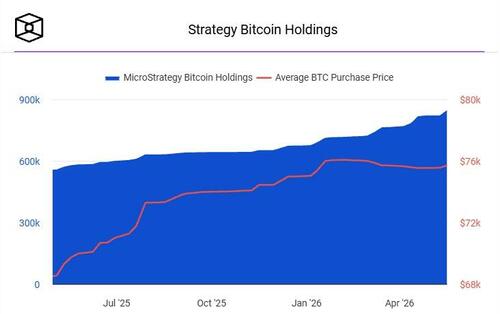
Saylor's Strategy Buys The Dip As Bitcoin Nears Mining Cost Floor A week after SELLING 32 Bitcoin - and (in part) triggering a waterfall decline in crypto - Bitcoin treasury company Strategy just BOUGHT an additional 1,550 BTC for approximately $101.3 million at an average price of $65,332 per bitcoin between June 1 and June 7, according to an 8-K filing with the SEC on Monday. Strategy now holds a total of 845,256 BTC - worth around $53.5 billion - bought at an average price of $75,680 per bitcoin for a total cost of around $64 billion, including fees and expenses, according to the company's co-founder and executive chairman, Michael Saylor. This means Saylor's horde represents 4% of bitcoin's 21 million supply

Key takeaway

"Saylor's Strategy Buys The Dip As Bitcoin Nears Mining Cost Floor" — BullBear's AI rates this story as a mixed, direction-neutral signal, with a market-impact score of 0 out of 100. Saylor's Strategy Buys The Dip As Bitcoin Nears Mining Cost Floor A week after SELLING 32 Bitcoin - and (in part) triggering a waterfall decline in crypto - Bitcoin treasury company Strategy just BOUGHT an additional 1,550 BTC for approximately $101.3 million at an average price of $65,332 per bitcoin between June 1 and June 7, according to an 8-K filing with the SEC on Monday. Strategy now holds a total of 845,256 BTC - worth around $53.5 billion - bought at an average price of $75,680 per bitcoin for a total cost of around $64 billion, including fees and expenses, according to the company's co-founder and executive chairman, Michael Saylor. This means Saylor's horde represents 4% of bitcoin's 21 million supply Reported by ZeroHedge on June 08, 2026. The call is verified against the actual 24-hour price move on BullBear's public conviction ledger.

Get the next high-impact catalyst

Telegram alerts when our AI scores a story 80+/100 impact (~1-3 per day, no spam). Verified 30d hit rate 53.4%.

Join Telegram channel

📡 Tomorrow's Watch

Related news

▼ Bear
85/100
Google News Macroeconomics (EN) 48m ago

Surging oil prices reignite inflation concerns, triggering another wave of sharp sell-offs in global bond markets.

Rewritten: Rising oil prices fuel inflation worries, sparking bond market sell-offs.

Surging oil prices reignite inflation concerns, triggering another wave of sharp sell-offs in global bond markets.

The recent ascent in crude oil prices is a significant factor contributing to heightened inflation concerns across the global economy. This upward pressure on energy costs directly impacts broader price levels, potentially eroding purchasing power and influencing consumer spending patterns. The renewed focus on inflation is prompting a reassessment of asset valuations, particularly within fixed income markets where rising inflation expectations can lead to decreased bond prices. This dynamic creates a more cautious investment landscape, as market participants navigate the implications of sustained price increases on economic growth and central bank policy. The interconnectedness of energy prices with supply chain dynamics and overall economic stability underscores the current market sentiment, which leans towards a more defensive posture.

The recent ascent in crude oil prices is a significant factor contributing to heightened inflation concerns across the global economy. This upward pressure on energy costs directly impacts broader price levels, potentially eroding purchasing power and influencing consumer spending patterns. The renewed focus on inflation is prompting a reassessment of asset valuations, particularly within fixed income markets where rising inflation expectations can lead to decreased bond prices. This dynamic creates a more cautious investment landscape, as market participants navigate the implications of sustained price increases on economic growth and central bank policy. The interconnectedness of energy prices with supply chain dynamics and overall economic stability underscores the current market sentiment, which leans towards a more defensive posture.

#macro
▼ Bear
75/100
Google News Macroeconomics (EN) 2h ago

Gold Prices Fall on Fed Rate Hike Prospects; Brent Crude Tops $100

Rewritten: Gold drops as Fed rate hike looms; Brent crude exceeds $100.

Gold prices are declining due to increased expectations of a Federal Reserve interest rate hike, while Brent crude oil has surpassed $100 per barrel.

The prospect of continued monetary tightening by the Federal Reserve is casting a shadow over risk assets, prompting a retreat in gold prices. This shift in central bank policy expectations is fostering a more cautious market sentiment, as investors weigh the potential for slower economic growth against inflationary pressures. The sustained strength in Brent crude oil, meanwhile, underscores persistent supply-side concerns and contributes to a broader macroeconomic narrative of elevated energy costs. Such an environment can erode investor confidence, leading to a reduced appetite for speculative investments and a preference for perceived safe havens, though even gold is facing headwinds from rising interest rate expectations. This dynamic suggests a recalibration of risk premiums across various asset classes as economic conditions evolve.

The prospect of continued monetary tightening by the Federal Reserve is casting a shadow over risk assets, prompting a retreat in gold prices. This shift in central bank policy expectations is fostering a more cautious market sentiment, as investors weigh the potential for slower economic growth against inflationary pressures. The sustained strength in Brent crude oil, meanwhile, underscores persistent supply-side concerns and contributes to a broader macroeconomic narrative of elevated energy costs. Such an environment can erode investor confidence, leading to a reduced appetite for speculative investments and a preference for perceived safe havens, though even gold is facing headwinds from rising interest rate expectations. This dynamic suggests a recalibration of risk premiums across various asset classes as economic conditions evolve.

#macro
▼ Bear
70/100
Google News Macroeconomics (EN) 3h ago

Gold Prices Ease as Inflation Concerns Reinforce Expectations for Higher Fed Rates

Rewritten: Gold falls on inflation fears, Fed rate hike outlook.

Gold prices have declined as ongoing inflation concerns strengthen expectations for further interest rate hikes by the Federal Reserve.

The recent downward movement in gold prices reflects an adjustment to prevailing economic indicators, specifically inflation data that strengthens the likelihood of continued increases in benchmark interest rates by the Federal Reserve. This anticipated tightening of monetary policy creates an environment where the cost of borrowing rises, potentially diminishing investor appetite for speculative ventures. As interest rates climb, the attractiveness of assets offering fixed returns may increase, prompting a reassessment of investment strategies. Consequently, market participants might favor less volatile assets or reduce their holdings in sectors perceived as more susceptible to economic headwinds. The dynamic between rising inflation, central bank responses, and the performance of commodities like gold highlights a period of significant economic recalibration.

The recent downward movement in gold prices reflects an adjustment to prevailing economic indicators, specifically inflation data that strengthens the likelihood of continued increases in benchmark interest rates by the Federal Reserve. This anticipated tightening of monetary policy creates an environment where the cost of borrowing rises, potentially diminishing investor appetite for speculative ventures. As interest rates climb, the attractiveness of assets offering fixed returns may increase, prompting a reassessment of investment strategies. Consequently, market participants might favor less volatile assets or reduce their holdings in sectors perceived as more susceptible to economic headwinds. The dynamic between rising inflation, central bank responses, and the performance of commodities like gold highlights a period of significant economic recalibration.

#macro
▼ Bear
75/100
Google News Macroeconomics (EN) 3h ago

Asia currencies weaken as Trump tariffs revive inflation fears, boost dollar

Rewritten: Asian currencies fall as tariffs renew inflation concerns, strengthen dollar.

Asia currencies weaken as Trump tariffs revive inflation fears, boost dollar.

Renewed trade tensions, specifically the reintroduction of tariffs by the United States, are casting a shadow over Asian currency markets, prompting a broad-based weakening. This development injects fresh concerns about inflationary pressures, not only within the affected economies but also potentially globally, as supply chains face further disruption. The resulting uncertainty is bolstering demand for safe-haven assets, notably the US dollar, which benefits from its traditional role as a refuge during times of geopolitical and economic stress. This shift in sentiment dampens investor confidence, leading to a reduced appetite for riskier assets and potentially prompting a reallocation of capital towards more defensive positions. The interconnectedness of global markets means these regional currency movements could have ripple effects, influencing commodity prices and broader equity market performance as investors recalibrate their expectations for global growth and inflation.

Renewed trade tensions, specifically the reintroduction of tariffs by the United States, are casting a shadow over Asian currency markets, prompting a broad-based weakening. This development injects fresh concerns about inflationary pressures, not only within the affected economies but also potentially globally, as supply chains face further disruption. The resulting uncertainty is bolstering demand for safe-haven assets, notably the US dollar, which benefits from its traditional role as a refuge during times of geopolitical and economic stress. This shift in sentiment dampens investor confidence, leading to a reduced appetite for riskier assets and potentially prompting a reallocation of capital towards more defensive positions. The interconnectedness of global markets means these regional currency movements could have ripple effects, influencing commodity prices and broader equity market performance as investors recalibrate their expectations for global growth and inflation.

#macro