US Fed says Iran war driving ‘moderate-to-strong’ inflation
The US Federal Reserve has stated that the war with Iran is driving 'moderate-to-strong' inflation.
How this call is verified
The ▼ Bearish call is auto-verified against the actual S&P 500 price
shortly.
Bar: S&P 500 ±0.3% within 24h · every verdict lands on the public ledger
Key takeaway
"US Fed says Iran war driving ‘moderate-to-strong’ inflation" — BullBear's AI rates this story as a bearish (negative) signal for markets, with a market-impact score of 75 out of 100. The US Federal Reserve has stated that the war with Iran is driving 'moderate-to-strong' inflation. Reported by Google News Macroeconomics (EN) on June 04, 2026. The call is verified against the actual 24-hour price move on BullBear's public conviction ledger.
Rewritten: Google: AI's workplace impact may not be job-ending.
A Google report indicates that AI is being utilized in 68% of occupations, representing 88% of US employment, not by automating jobs away, but by assisting workers in performing their tasks more effectively.
Analysis of recent workplace AI integration data indicates a divergence from purely disruptive scenarios, suggesting a more collaborative relationship between artificial intelligence and human labor. This evolving understanding could foster a more optimistic outlook on technological advancement's impact on employment. From a broader economic standpoint, this aligns with historical patterns where innovation drives productivity and economic expansion. Such insights may contribute to increased investor confidence by mitigating concerns about widespread job obsolescence. Consequently, market sentiment could shift towards recognizing the potential for AI to enhance efficiency and spur innovation, influencing investment decisions and asset valuations across diverse sectors as businesses adapt to leverage these capabilities.
Rewritten: Fed rate hike odds rise with soaring oil prices.
The odds of a Federal Reserve rate hike are surging as oil prices rise sharply.
The upward trajectory of crude oil prices is demonstrably elevating the perceived likelihood of additional interest rate increases by the Federal Reserve. This shift in monetary policy expectations injects a bearish outlook into financial markets, potentially tempering investor enthusiasm and prompting a reassessment of risk tolerance. The link to prevailing macroeconomic trends is clear, as persistent inflationary pressures, now amplified by energy sector dynamics, cast doubt on projections of a smooth economic deceleration. As a result, market participants might display diminished confidence, leading to a preference for more conservative investment strategies in anticipation of elevated borrowing expenses. This environment could manifest as heightened market fluctuations and a more circumspect stance regarding equity market exposure.
Rewritten: Abraham Accords complicate Saudi nuclear deal late.
Former President Trump's intervention in the Saudi nuclear deal, linking it to the Abraham Accords, has introduced significant geopolitical uncertainty in the Middle East.
The unexpected intervention by former President Trump regarding the potential Saudi nuclear deal injects significant uncertainty into a delicate geopolitical landscape. This development could cast a shadow over the Abraham Accords, potentially impacting regional stability and investor confidence in Middle Eastern markets. The broader market implications may include increased volatility as traders reassess the geopolitical risk premium associated with the region. This uncertainty can dampen market sentiment, leading to a more cautious approach from investors and a reduced appetite for riskier assets. The situation also touches upon macro themes of energy security and the evolving global balance of power, further complicating the outlook for international trade and investment flows. Consequently, investor confidence may waver, prompting a flight to perceived safe-haven assets.
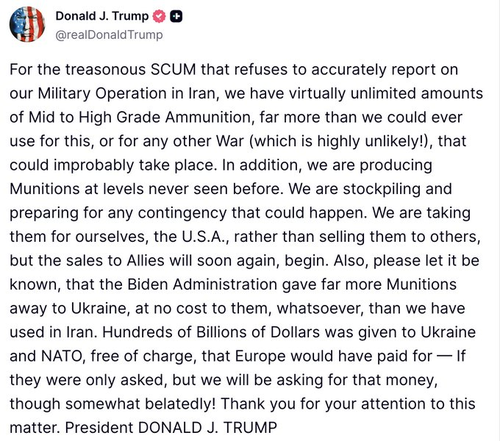
Oil prices surged six percent, with Brent crude above $100 and WTI at $92, attributed to escalating tensions between Trump and Iran.
The significant jump in oil prices, with Brent surpassing $100 and WTI reaching $92, injects a decidedly bearish tone into broader market considerations. This surge, attributed in part to geopolitical factors potentially influenced by former President Trump's rhetoric, amplifies existing inflationary concerns and casts a shadow over economic growth prospects. Market sentiment is likely to shift towards caution, as higher energy costs erode consumer purchasing power and increase operating expenses for businesses across various sectors. This development reinforces macro themes of supply-side disruptions and geopolitical instability, directly impacting investor confidence. Consequently, risk appetite may diminish, leading to a potential reallocation of capital away from growth-oriented assets towards safer havens as uncertainty surrounding future energy supplies and their economic ramifications persists.
#macro
Get the next 80+ impact catalyst
Push notifications when our AI flags a high-impact bull/bear story. ~1–3 per day.