"Fed’s Kashkari warns Iran war raises inflation risks, rate cuts uncertain" — BullBear's AI rates this story as a bearish (negative) signal for markets, with a market-impact score of 95 out of 100. Reported by Google News Macroeconomics (EN) on May 03, 2026. The call is verified against the actual 24-hour price move on BullBear's public conviction ledger.
Catch the next bear flag
Telegram alerts when our AI scores a story 80+/100 impact (~1-3 per day, no spam).
Verified 30d hit rate 40.2%.
Putin Says There's A Chance Of Ukraine Peace Deal, Wants To Restore Full US Relations
Authored by Guy Birchall via The Epoch Times,
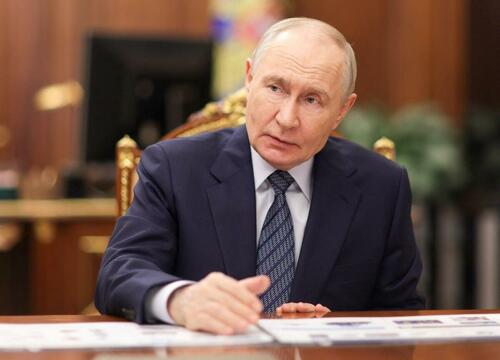
Russian President Vladimir Putin said on Sept. 3 that there was "a chance" of achieving peace with Ukraine and expressed a desire to rekindle relations with the United States.
Putin was speaking at a session of the Eastern Economic Forum (EEF) in Vladivostok when he made the comments.
On the subject of Ukraine, the Russian president said Moscow was "grateful to everyone who is trying to contribute to resolving this issue," and he said that in his opinion there is "a chance" of peace, according to Russian state news agency TASS.
He said that for hostilities to end between Moscow and Kyiv, "Russia and Ukraine must first reach an agreement" between themselves, and he acknowledged that "al
Ongoing tensions in the Strait of Hormuz, highlighted by a warning from a major Japanese tanker operator about potential disruptions extending into next year, could reverberate across global energy markets. A prolonged bottleneck would tighten crude and refined product supplies, nudging spot prices higher and pressuring inventories, which in turn may feed into broader commodity indices. Market sentiment could shift toward caution as traders price in heightened geopolitical risk premiums, dampening risk‑on flows into equities and favoring defensive assets. The scenario dovetails with macro‑level concerns over supply chain resilience and the interplay between energy security and inflationary pressures, reinforcing central banks' vigilance on price stability. Consequently, investor confidence may waver, prompting a modest pullback from higher‑yield exposures and a reallocation toward assets perceived as lower‑risk, potentially curbing appetite for speculative positions.
Ongoing tensions in the Strait of Hormuz, highlighted by a warning from a major Japanese tanker operator about potential disruptions extending into next year, could reverberate across global energy markets. A prolonged bottleneck would tighten crude and refined product supplies, nudging spot prices higher and pressuring inventories, which in turn may feed into broader commodity indices. Market sentiment could shift toward caution as traders price in heightened geopolitical risk premiums, dampening risk‑on flows into equities and favoring defensive assets. The scenario dovetails with macro‑level concerns over supply chain resilience and the interplay between energy security and inflationary pressures, reinforcing central banks' vigilance on price stability. Consequently, investor confidence may waver, prompting a modest pullback from higher‑yield exposures and a reallocation toward assets perceived as lower‑risk, potentially curbing appetite for speculative positions.

 or scan with phone →