"Korea Investment & Securities, Domestic Stock Futures & Options Trading Event" — BullBear's AI rates this story as a mixed, direction-neutral signal, with a market-impact score of 30 out of 100. Reported by Google News Economy on February 04, 2026. The call is verified against the actual 24-hour price move on BullBear's public conviction ledger.
Get the next high-impact catalyst
Telegram alerts when our AI scores a story 80+/100 impact (~1-3 per day, no spam).
Verified 30d hit rate 43.0%.
New York Rediscovers Nuclear Power, With Plenty Of Political Fine Print
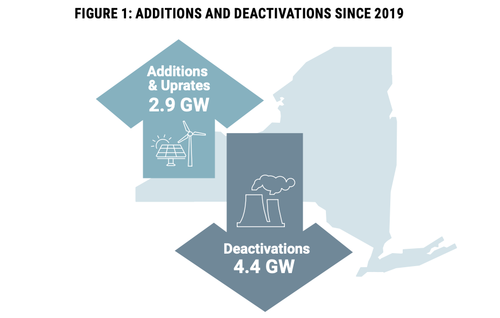
Five years after Indian Point’s last reactor shut down, Albany rediscovered the appeal of electricity that runs around the clock without burning fossil fuels.
Governor Kathy Hochul wants 5 gigawatts of new nuclear capacity, with at least 1 GW developed by the publicly owned New York Power Authority, plus a separate 4 GW initiative.
There haven't been any announcements for the technology of choice, but the most likely candidates are the large Westinghouse AP1000 and the smaller 300 MW BWRX-300 from GE Vernova Hitachi.
As Canary Media reports, the reversal follows this spring’s weakening of New York’s climate law. The state’s difficulties with delivering large renewable projects also hasn’t helped keep them on the pure-play renewables path, which was made worse with the Trump administration’s assault on offshore wind.
The construction of new nuclear power generation offers a governor facing re-election a unique win-win opportunity: nuclear offers dependable low-carbon generation alongside renewables while also offering industrial investment, construction jobs and promises of lower bills.
Eight upstate communities have
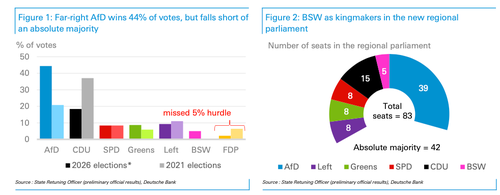
An unexpected surge for the far‑right Alternative für Deutschland reshapes Germany’s political calculus, prompting investors to reassess the stability of the country’s pro‑business agenda. The shift raises doubts about future fiscal discipline and could stall planned infrastructure spending, pressuring the DAX and other export‑oriented European equities. At the same time, heightened political risk may revive demand for safe‑haven assets such as the euro‑dollar and German bund yields, dampening risk‑on sentiment across broader markets. The development dovetails with broader macro concerns over populist backlash, slowing growth, and the EU’s ability to deliver cohesive policy responses, especially on energy transition and fiscal integration. Consequently, investor confidence may waver, prompting a more cautious risk appetite as market participants price in potential regulatory uncertainty and a possible re‑orientation of Germany’s role within the eurozone.
An unexpected surge for the far‑right Alternative für Deutschland reshapes Germany’s political calculus, prompting investors to reassess the stability of the country’s pro‑business agenda. The shift raises doubts about future fiscal discipline and could stall planned infrastructure spending, pressuring the DAX and other export‑oriented European equities. At the same time, heightened political risk may revive demand for safe‑haven assets such as the euro‑dollar and German bund yields, dampening risk‑on sentiment across broader markets. The development dovetails with broader macro concerns over populist backlash, slowing growth, and the EU’s ability to deliver cohesive policy responses, especially on energy transition and fiscal integration. Consequently, investor confidence may waver, prompting a more cautious risk appetite as market participants price in potential regulatory uncertainty and a possible re‑orientation of Germany’s role within the eurozone.
The resurgence of Hegseth’s polygraph program at the Pentagon, framed as a ‘major leak hunt’ tied to the ongoing Iran conflict, injects fresh geopolitical uncertainty into markets. Investors may interpret the move as an indication that U.S. intelligence agencies are tightening internal controls, potentially slowing the flow of information that could affect defense procurement and broader foreign‑policy decisions. Such ambiguity tends to dampen risk appetite, prompting a shift toward safer assets and pressuring equities, especially those with exposure to defense and energy sectors that are sensitive to Middle‑East tensions. At the macro level, the episode underscores lingering geopolitical fragility and the possibility of heightened fiscal scrutiny, which can weigh on growth expectations. Consequently, confidence among investors could erode, reinforcing a cautious stance and limiting speculative positioning until clearer signals emerge.
The resurgence of Hegseth’s polygraph program at the Pentagon, framed as a ‘major leak hunt’ tied to the ongoing Iran conflict, injects fresh geopolitical uncertainty into markets. Investors may interpret the move as an indication that U.S. intelligence agencies are tightening internal controls, potentially slowing the flow of information that could affect defense procurement and broader foreign‑policy decisions. Such ambiguity tends to dampen risk appetite, prompting a shift toward safer assets and pressuring equities, especially those with exposure to defense and energy sectors that are sensitive to Middle‑East tensions. At the macro level, the episode underscores lingering geopolitical fragility and the possibility of heightened fiscal scrutiny, which can weigh on growth expectations. Consequently, confidence among investors could erode, reinforcing a cautious stance and limiting speculative positioning until clearer signals emerge.
#macro
Get the next 80+ impact catalyst
Push notifications when our AI flags a high-impact bull/bear story. ~1–3 per day.

 or scan with phone →