Trump's Grid Battery Ban Leaves Developers Guessing
Key takeaway
"Trump's Grid Battery Ban Leaves Developers Guessing" — BullBear's AI rates this story as a bearish (negative) signal for markets, with a market-impact score of 55 out of 100. Reported by ZeroHedge on September 14, 2026. The call is verified against the actual 24-hour price move on BullBear's public conviction ledger.
Catch the next bear flag
Telegram alerts when our AI scores a story 80+/100 impact (~1-3 per day, no spam).
Verified 30d hit rate 42.0%.
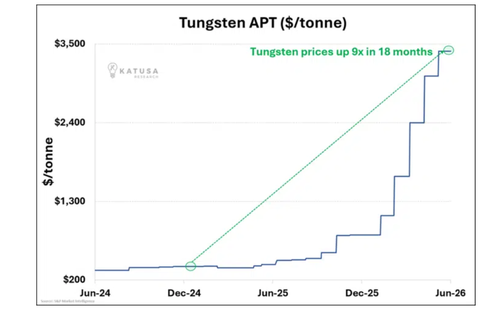
Heightened resource nationalism across key tungsten producers is tightening supply chains and amplifying price volatility in the broader base metals market. The United States’ restriction on scrap imports, the United Kingdom’s state‑backed financing of a new mine, Zimbabwe’s export ban, and Vietnam’s contemplation of export limits collectively signal a shift toward protectionist policies that constrain global availability. Such moves reinforce concerns about geopolitical risk and reinforce a narrative of constrained commodity flows, dampening bullish sentiment that had been buoyed by earlier demand forecasts. The tightening environment dovetails with macro‑level themes of de‑globalisation and supply‑side fragility, prompting investors to reassess exposure to metals reliant on politically sensitive jurisdictions. Consequently, confidence in the sector erodes, prompting a more cautious risk appetite and potentially prompting capital rotation toward less geopolitically exposed assets as well as longer‑term strategic allocations.
Heightened resource nationalism across key tungsten producers is tightening supply chains and amplifying price volatility in the broader base metals market. The United States’ restriction on scrap imports, the United Kingdom’s state‑backed financing of a new mine, Zimbabwe’s export ban, and Vietnam’s contemplation of export limits collectively signal a shift toward protectionist policies that constrain global availability. Such moves reinforce concerns about geopolitical risk and reinforce a narrative of constrained commodity flows, dampening bullish sentiment that had been buoyed by earlier demand forecasts. The tightening environment dovetails with macro‑level themes of de‑globalisation and supply‑side fragility, prompting investors to reassess exposure to metals reliant on politically sensitive jurisdictions. Consequently, confidence in the sector erodes, prompting a more cautious risk appetite and potentially prompting capital rotation toward less geopolitically exposed assets as well as longer‑term strategic allocations.
Developments in the Gulf that bring Iranian officials to the United Arab Emirates and hint at a potential Oman‑based shipping arrangement signal a thaw in regional diplomatic friction, which could smooth trade corridors for energy and commodities. A more stable geopolitical environment tends to lower the risk premium on Middle‑East assets, encouraging capital inflows into equities and sovereign bonds linked to the area. The prospect of a formalized maritime link may also boost logistics and shipping firms that serve the Persian Gulf, adding a sector‑specific catalyst. In the broader macro context, reduced tension aligns with global efforts to secure energy supplies and mitigate supply‑chain disruptions, reinforcing expectations of steadier oil flows. Consequently, investor confidence is likely to improve, prompting a modest shift toward higher‑risk, higher‑return positions in the region while maintaining a cautious stance on broader market volatility.
Developments in the Gulf that bring Iranian officials to the United Arab Emirates and hint at a potential Oman‑based shipping arrangement signal a thaw in regional diplomatic friction, which could smooth trade corridors for energy and commodities. A more stable geopolitical environment tends to lower the risk premium on Middle‑East assets, encouraging capital inflows into equities and sovereign bonds linked to the area. The prospect of a formalized maritime link may also boost logistics and shipping firms that serve the Persian Gulf, adding a sector‑specific catalyst. In the broader macro context, reduced tension aligns with global efforts to secure energy supplies and mitigate supply‑chain disruptions, reinforcing expectations of steadier oil flows. Consequently, investor confidence is likely to improve, prompting a modest shift toward higher‑risk, higher‑return positions in the region while maintaining a cautious stance on broader market volatility.
An anticipated Democratic majority in the House could steer policy toward tighter oversight of data‑center construction, renewed scrutiny of nuclear projects, and a contentious oil agreement with Venezuela, creating a cascade of sector‑specific headwinds. Investors may interpret heightened regulatory risk and geopolitical uncertainty as signals that earnings growth in these high‑capital‑intensive industries could be constrained, prompting a shift toward defensive assets. This dovetails with broader macro themes of tightening fiscal policy and a re‑evaluation of energy security strategies, reinforcing a risk‑averse stance across equity markets. As confidence in the stability of policy frameworks erodes, risk appetite is likely to contract, weighing on valuation multiples and potentially dampening broader market momentum. Higher bond yields and a firmer dollar could further amplify the pullback, as capital flows gravitate to safer havens and lower‑risk sectors such as utilities and consumer staples.
An anticipated Democratic majority in the House could steer policy toward tighter oversight of data‑center construction, renewed scrutiny of nuclear projects, and a contentious oil agreement with Venezuela, creating a cascade of sector‑specific headwinds. Investors may interpret heightened regulatory risk and geopolitical uncertainty as signals that earnings growth in these high‑capital‑intensive industries could be constrained, prompting a shift toward defensive assets. This dovetails with broader macro themes of tightening fiscal policy and a re‑evaluation of energy security strategies, reinforcing a risk‑averse stance across equity markets. As confidence in the stability of policy frameworks erodes, risk appetite is likely to contract, weighing on valuation multiples and potentially dampening broader market momentum. Higher bond yields and a firmer dollar could further amplify the pullback, as capital flows gravitate to safer havens and lower‑risk sectors such as utilities and consumer staples.
With the personal consumption expenditures price index slated for a September‑30 revision, policymakers are likely to pause any immediate rate hikes, a stance that could temper volatility across equities and fixed‑income markets. The prospect of a more accurate inflation gauge reduces the risk of premature tightening, supporting a modest rally in growth‑sensitive sectors while keeping defensive assets in check. Investor sentiment may shift from defensive caution to a tentative optimism, as the uncertainty surrounding the data’s reliability eases and the narrative of a “soft landing” gains traction. This dynamic ties into broader macro themes of data‑driven monetary policy and the ongoing debate over the Fed’s inflation‑targeting framework, reinforcing confidence that policy will remain responsive rather than reactionary. Consequently, risk appetite is likely to broaden, though lingering doubts about the timing and magnitude of future adjustments will keep some investors guarded.
With the personal consumption expenditures price index slated for a September‑30 revision, policymakers are likely to pause any immediate rate hikes, a stance that could temper volatility across equities and fixed‑income markets. The prospect of a more accurate inflation gauge reduces the risk of premature tightening, supporting a modest rally in growth‑sensitive sectors while keeping defensive assets in check. Investor sentiment may shift from defensive caution to a tentative optimism, as the uncertainty surrounding the data’s reliability eases and the narrative of a “soft landing” gains traction. This dynamic ties into broader macro themes of data‑driven monetary policy and the ongoing debate over the Fed’s inflation‑targeting framework, reinforcing confidence that policy will remain responsive rather than reactionary. Consequently, risk appetite is likely to broaden, though lingering doubts about the timing and magnitude of future adjustments will keep some investors guarded.
#macro
Get the next 80+ impact catalyst
Push notifications when our AI flags a high-impact bull/bear story. ~1–3 per day.

 or scan with phone →