Energy Secretary Wright Says Venezuela Could More Than Double Oil Production
Key takeaway
"Energy Secretary Wright Says Venezuela Could More Than Double Oil Production" — BullBear's AI rates this story as a mixed, direction-neutral signal, with a market-impact score of 70 out of 100. Reported by ZeroHedge on September 02, 2026. The call is verified against the actual 24-hour price move on BullBear's public conviction ledger.
Get the next high-impact catalyst
Telegram alerts when our AI scores a story 80+/100 impact (~1-3 per day, no spam).
Verified 30d hit rate 45.4%.
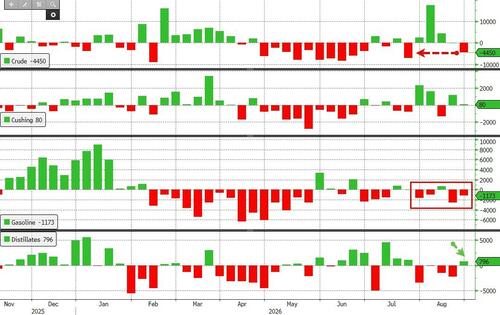
Amid renewed hostilities between the United States and Iran, the surge in WTI to five‑week highs coincides with U.S. crude output reaching record levels and storage at Cushing and the Strategic Petroleum Reserve approaching capacity constraints. The juxtaposition of geopolitical tension and abundant supply pressures the market to price in a narrower upside, tempering bullish momentum despite the short‑term rally. Sentiment shifts toward caution as traders weigh the risk of supply disruptions against the likelihood of continued inventory builds, reinforcing a broader macro narrative of resilient demand offset by expanding production and strategic stockpiling. Investor confidence is likely to waver, with risk‑averse capital gravitating toward assets perceived as less exposed to oil price volatility, while speculative positions may shrink as the outlook remains mixed.
Amid renewed hostilities between the United States and Iran, the surge in WTI to five‑week highs coincides with U.S. crude output reaching record levels and storage at Cushing and the Strategic Petroleum Reserve approaching capacity constraints. The juxtaposition of geopolitical tension and abundant supply pressures the market to price in a narrower upside, tempering bullish momentum despite the short‑term rally. Sentiment shifts toward caution as traders weigh the risk of supply disruptions against the likelihood of continued inventory builds, reinforcing a broader macro narrative of resilient demand offset by expanding production and strategic stockpiling. Investor confidence is likely to waver, with risk‑averse capital gravitating toward assets perceived as less exposed to oil price volatility, while speculative positions may shrink as the outlook remains mixed.
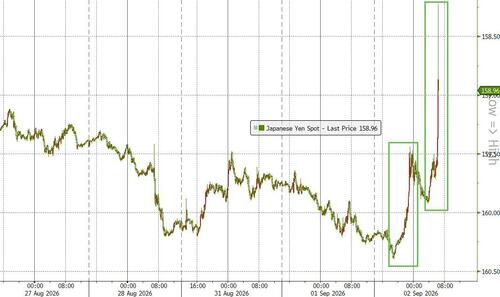
The unexpected yen rally, driven by speculation of Japanese authorities stepping in, reverberates across global markets as traders reassess currency risk and equity valuations. A sharper yen raises import costs for Japan’s export‑driven firms, pressuring Asian equities and prompting a modest pullback in risk‑on assets such as high‑yield bonds and emerging‑market currencies. The move also underscores lingering concerns over divergent monetary policies, with the Bank of Japan’s ultra‑loose stance contrasting sharply against tightening cycles in the United States and Europe, reinforcing a macro narrative of policy divergence fueling volatility. Investor confidence may waver as the prospect of intervention signals heightened central‑bank vigilance, dampening appetite for leveraged positions and prompting a shift toward defensive sectors. Overall, the spike injects caution into market sentiment, tempering risk appetite until clarity emerges on the durability of the yen’s move and any ensuing policy response.
The unexpected yen rally, driven by speculation of Japanese authorities stepping in, reverberates across global markets as traders reassess currency risk and equity valuations. A sharper yen raises import costs for Japan’s export‑driven firms, pressuring Asian equities and prompting a modest pullback in risk‑on assets such as high‑yield bonds and emerging‑market currencies. The move also underscores lingering concerns over divergent monetary policies, with the Bank of Japan’s ultra‑loose stance contrasting sharply against tightening cycles in the United States and Europe, reinforcing a macro narrative of policy divergence fueling volatility. Investor confidence may waver as the prospect of intervention signals heightened central‑bank vigilance, dampening appetite for leveraged positions and prompting a shift toward defensive sectors. Overall, the spike injects caution into market sentiment, tempering risk appetite until clarity emerges on the durability of the yen’s move and any ensuing policy response.
The alleged Leipzig incident, widely debated as a possible false‑flag operation, is injecting heightened uncertainty into global markets, prompting traders to reassess risk premiums across equities, commodities and currencies. If investors interpret the event as a manufactured escalation, it could reinforce narratives of escalating geopolitical manipulation, dampening confidence in the reliability of intelligence and amplifying demand for safe‑haven assets such as gold and the US dollar. Conversely, skepticism about the incident’s authenticity may revive risk‑on sentiment, encouraging a rebound in risk‑sensitive sectors. The episode dovetails with broader macro concerns over supply‑chain resilience, energy security and the credibility of regulatory oversight, all of which are already weighing on growth forecasts. Ultimately, the lingering ambiguity erodes investor confidence, tightening risk appetite until clearer evidence emerges or policy responses clarify the underlying dynamics.
The alleged Leipzig incident, widely debated as a possible false‑flag operation, is injecting heightened uncertainty into global markets, prompting traders to reassess risk premiums across equities, commodities and currencies. If investors interpret the event as a manufactured escalation, it could reinforce narratives of escalating geopolitical manipulation, dampening confidence in the reliability of intelligence and amplifying demand for safe‑haven assets such as gold and the US dollar. Conversely, skepticism about the incident’s authenticity may revive risk‑on sentiment, encouraging a rebound in risk‑sensitive sectors. The episode dovetails with broader macro concerns over supply‑chain resilience, energy security and the credibility of regulatory oversight, all of which are already weighing on growth forecasts. Ultimately, the lingering ambiguity erodes investor confidence, tightening risk appetite until clearer evidence emerges or policy responses clarify the underlying dynamics.
The prospect of a drawn‑out conflict centered on assets whose intrinsic worth is expected to decline sharply within a short horizon adds a layer of geopolitical risk that can reverberate across financial markets. Uncertainty about the duration and economic cost of such a war may prompt investors to shift toward lower‑risk instruments, thereby compressing risk premia and reducing liquidity in more speculative segments. This behavior dovetails with existing macro‑level worries about resource constraints and the long‑term viability of current consumption models, amplifying concerns over supply‑chain disruptions and fiscal burdens on the involved economies. As market participants reassess exposure to sectors tied to the contested assets, valuation metrics could be adjusted downward, while defensive industries—such as utilities, consumer staples, and healthcare—might experience relative strength. Overall, the interplay between geopolitical irrationality and underlying structural challenges could foster a more cautious market stance and trigger broader re‑pricing of risk.
The prospect of a drawn‑out conflict centered on assets whose intrinsic worth is expected to decline sharply within a short horizon adds a layer of geopolitical risk that can reverberate across financial markets. Uncertainty about the duration and economic cost of such a war may prompt investors to shift toward lower‑risk instruments, thereby compressing risk premia and reducing liquidity in more speculative segments. This behavior dovetails with existing macro‑level worries about resource constraints and the long‑term viability of current consumption models, amplifying concerns over supply‑chain disruptions and fiscal burdens on the involved economies. As market participants reassess exposure to sectors tied to the contested assets, valuation metrics could be adjusted downward, while defensive industries—such as utilities, consumer staples, and healthcare—might experience relative strength. Overall, the interplay between geopolitical irrationality and underlying structural challenges could foster a more cautious market stance and trigger broader re‑pricing of risk.
Recent visualizations of Canada's export landscape reveal a tightening concentration toward a few dominant partners, while growth in traditionally robust markets has stalled, signaling potential headwinds for the country's trade‑driven sectors. The narrowing of destination diversity amplifies exposure to geopolitical tensions and commodity price volatility, which could dampen broader market sentiment as investors reassess earnings forecasts for resource‑heavy firms. This pattern dovetails with macro themes of de‑globalisation and shifting supply‑chain strategies, reinforcing concerns that Canada may struggle to offset slowing demand from its top buyers. Consequently, investor confidence may erode, prompting a more cautious risk appetite and prompting capital rotation toward assets perceived as less dependent on external trade flows. The emerging picture underscores the need for policymakers to diversify markets and for market participants to factor heightened trade risk into valuation models.
Recent visualizations of Canada's export landscape reveal a tightening concentration toward a few dominant partners, while growth in traditionally robust markets has stalled, signaling potential headwinds for the country's trade‑driven sectors. The narrowing of destination diversity amplifies exposure to geopolitical tensions and commodity price volatility, which could dampen broader market sentiment as investors reassess earnings forecasts for resource‑heavy firms. This pattern dovetails with macro themes of de‑globalisation and shifting supply‑chain strategies, reinforcing concerns that Canada may struggle to offset slowing demand from its top buyers. Consequently, investor confidence may erode, prompting a more cautious risk appetite and prompting capital rotation toward assets perceived as less dependent on external trade flows. The emerging picture underscores the need for policymakers to diversify markets and for market participants to factor heightened trade risk into valuation models.
#macro
Get the next 80+ impact catalyst
Push notifications when our AI flags a high-impact bull/bear story. ~1–3 per day.

 or scan with phone →