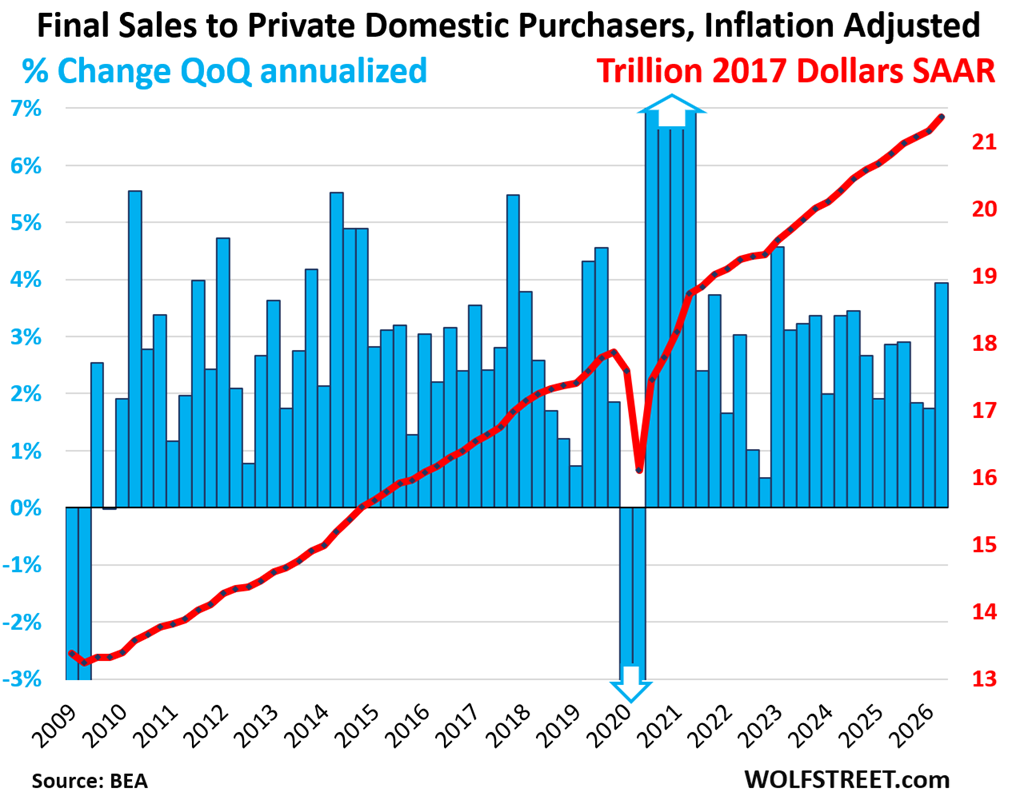
Red-Hot Inflation & (Inflation-Adjusted) Strong Domestic Private-Sector Demand Marks Q2 GDP. Debt-to-GDP Ratio Dips to 121.5%
But soaring imports (data-center components), a drop in federal government spending, and changes in private inventories ate into GDP growth.
Key takeaway
"Red-Hot Inflation & (Inflation-Adjusted) Strong Domestic Private-Sector Demand Marks Q2 GDP. Debt-to-GDP Ratio Dips to 121.5%" — BullBear's AI rates this story as a mixed, direction-neutral signal, with a market-impact score of 75 out of 100. But soaring imports (data-center components), a drop in federal government spending, and changes in private inventories ate into GDP growth. Reported by Wolf Street on July 30, 2026. The call is verified against the actual 24-hour price move on BullBear's public conviction ledger.
Get the next high-impact catalyst
Telegram alerts when our AI scores a story 80+/100 impact (~1-3 per day, no spam).
Verified 30d hit rate 50.9%.
Core PCE inflation was 3.3% in June, edging down from May.
The slight deceleration in core PCE inflation to 3.3% offers a nuanced signal for market participants. While a step in the right direction, the persistent elevated level continues to fuel concerns about the Federal Reserve's path forward, potentially prolonging a restrictive monetary policy stance. This could translate into broader market implications of sustained volatility and a cautious approach to risk assets. Market sentiment may remain subdued, as investors grapple with the possibility of higher-for-longer interest rates impacting corporate earnings and economic growth prospects. The connection to macro themes of sticky inflation and the challenges of achieving a soft landing remains prominent. Consequently, investor confidence might be tempered, leading to a reduced appetite for riskier investments as the focus shifts towards capital preservation and defensive positioning.
Warsh hints at a new inflation roadmap, stoking investor angst.
The discourse around potential adjustments to central bank inflation management approaches, as suggested by recent commentary, is introducing a notable degree of uncertainty into financial markets. This speculation may be interpreted by investors as an indication of forthcoming policy shifts, potentially contributing to heightened market fluctuations and a more risk-averse stance towards speculative investments. This situation arises within a broader context of persistent inflationary pressures and ongoing questions about the effectiveness of existing monetary policy instruments. As a result, investor sentiment could face challenges, necessitating a reassessment of risk tolerance as market participants analyze the potential ramifications of an evolving inflation strategy on economic expansion and the valuation of various asset classes.
Rewritten: Yardeni: Bond investors seek Fed vigilance on inflation.
Ed Yardeni states that the bond market wants the Fed to be more vigilant on inflation.
The bond market's expressed preference for heightened Federal Reserve attention to inflation indicates a developing apprehension regarding sustained price increases. This sentiment suggests a potential recalibration of economic forecasts among market participants, influencing expectations for future interest rate adjustments and overall economic expansion. A sustained focus on inflation by the central bank, prompted by these bond market signals, could introduce greater uncertainty into monetary policy, potentially affecting overall market sentiment. This aligns with macroeconomic discussions around the possibility of stagflation or an extended period of elevated inflation. Such conditions may lead to a reduction in investor confidence, as the perceived risk associated with holding riskier assets increases. Consequently, a contraction in risk appetite could emerge, with investors potentially favoring more defensive asset allocations in anticipation of challenges stemming from a more hawkish monetary stance and persistent inflation.
The credibility of the Fed chair on Wall Street is being questioned as investors doubt his resolve in fighting inflation.
Market participants are expressing increased skepticism about the Federal Reserve's commitment to combating inflation, a sentiment that is influencing broader economic outlooks. This perceived shift in resolve could potentially allow inflationary forces to persist, leading to extended periods of higher price levels and consequently affecting projections for corporate profitability. Such uncertainty amplifies existing macroeconomic concerns, including ongoing supply chain issues and geopolitical tensions, contributing to a more risk-averse investment climate. As a result, investor confidence may diminish, leading to a decreased inclination to invest in higher-risk assets as capital gravitates towards assets considered more secure. Future communications from the central bank will be closely monitored for indications of a return to a more restrictive monetary policy stance, which could potentially restore market confidence, or conversely, for further ambiguity that might intensify downward market pressures.