Choose language / Korean

EN / 한
Tungsten Miner Soars After Billionaire Forrest Takes 17% Stake
Bull/Bear Index 46.2/100
macro ▲ Bull Impact 40/100 ZeroHedge 2d ago Read original ↗

Tungsten Miner Soars After Billionaire Forrest Takes 17% Stake

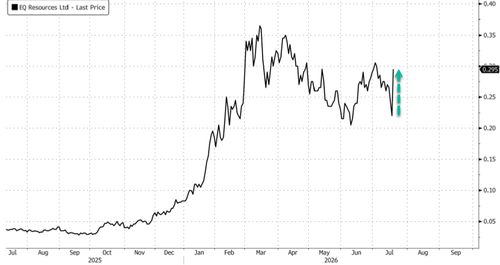
Australian mining billionaire Andrew Forrest has agreed to acquire Oaktree Capital's entire 16.8% stake in the Sydney-listed tungsten producer EQ Resources. Shares of EQ Resources in Sydney surged 34% on Monday following news of the transaction, which is valued at about 190 million AUD ($133 million) based on Friday's close.

Key takeaway

"Tungsten Miner Soars After Billionaire Forrest Takes 17% Stake" — BullBear's AI rates this story as a bullish (positive) signal for markets, with a market-impact score of 40 out of 100. Australian mining billionaire Andrew Forrest has agreed to acquire Oaktree Capital's entire 16.8% stake in the Sydney-listed tungsten producer EQ Resources. Shares of EQ Resources in Sydney surged 34% on Monday following news of the transaction, which is valued at about 190 million AUD ($133 million) based on Friday's close. Reported by ZeroHedge on July 20, 2026. The call is verified against the actual 24-hour price move on BullBear's public conviction ledger.

Catch the next bull catalyst

Telegram alerts when our AI scores a story 80+/100 impact (~1-3 per day, no spam). Verified 30d hit rate 53.2%.

Join Telegram channel

📡 Tomorrow's Watch

Related news

40/100
ZeroHedge 2h ago

Overeducated Liberals With Worthless Degrees Are DSA's "Sweet Spot" Voter

Overeducated Liberals With Worthless Degrees Are DSA's "Sweet Spot" Voter. Nate Silver identifies lower-income, highly educated voters as the core demographic of the Democratic Socialists of America, revealing a striking breakdown in the traditional relationship between education and higher income.

#macro
▼ Bear
85/100
ZeroHedge 3h ago

Despite Big Bounce In Revenues, TSLA Shares Drop After Disappointing Earnings

Rewritten: TSLA Stock Falls Despite Revenue Growth, Earnings Disappoint

Despite a significant increase in revenues, Tesla's shares fell after reporting disappointing earnings, with EPS missing expectations due to higher AI and R&D spending.

The recent market reaction to TSLA's performance, characterized by a revenue increase yet a share price decline, underscores a heightened investor focus on profitability and the sustainability of future growth. This disconnect between revenue expansion and market valuation indicates a potential recalibration of investor expectations, moving beyond top-line figures to a more rigorous assessment of earnings potential. Such a trend can cast a shadow over sectors heavily reliant on growth narratives, as it signals a possible pivot in investment strategy towards companies demonstrating robust cash generation and a clear trajectory towards profitability. This shift aligns with broader economic considerations, including inflationary pressures and rising interest rates, which often lead investors to favor established earnings over speculative ventures. As a result, investor sentiment may become more cautious, fostering a more discerning investment environment and a reduced tolerance for risk across the equity landscape.

The recent market reaction to TSLA's performance, characterized by a revenue increase yet a share price decline, underscores a heightened investor focus on profitability and the sustainability of future growth. This disconnect between revenue expansion and market valuation indicates a potential recalibration of investor expectations, moving beyond top-line figures to a more rigorous assessment of earnings potential. Such a trend can cast a shadow over sectors heavily reliant on growth narratives, as it signals a possible pivot in investment strategy towards companies demonstrating robust cash generation and a clear trajectory towards profitability. This shift aligns with broader economic considerations, including inflationary pressures and rising interest rates, which often lead investors to favor established earnings over speculative ventures. As a result, investor sentiment may become more cautious, fostering a more discerning investment environment and a reduced tolerance for risk across the equity landscape.

#macro
▼ Bear
85/100
ZeroHedge 3h ago

Trump Vows US Will Destroy A Bridge Or Power Plant For Each Iranian Attack On Shipping

Rewritten: US to target infrastructure for each Iranian shipping attack.

Trump Vows US Will Destroy A Bridge Or Power Plant For Each Iranian Attack On Shipping

The stated intention to retaliate against specific Iranian actions with direct strikes on infrastructure introduces a substantial geopolitical risk premium into the global economic landscape. This escalation could significantly impact the stability of a vital energy-producing area, fostering an environment of increased uncertainty. Such conditions often lead to a more cautious investor sentiment, manifesting as heightened price swings in both stock and raw material sectors as market participants adjust their expectations for potential disruptions to essential supplies. The pronouncement aligns with broader discussions regarding energy security and international diplomatic approaches, signaling a potential move towards more assertive foreign policy. This heightened unpredictability may diminish overall investor confidence, potentially driving capital towards less volatile investments and a general decrease in the willingness to assume risk. The possibility of targeted military engagements introduces a new variable, complicating forecasting and long-term strategic decision-making for economic actors.

The stated intention to retaliate against specific Iranian actions with direct strikes on infrastructure introduces a substantial geopolitical risk premium into the global economic landscape. This escalation could significantly impact the stability of a vital energy-producing area, fostering an environment of increased uncertainty. Such conditions often lead to a more cautious investor sentiment, manifesting as heightened price swings in both stock and raw material sectors as market participants adjust their expectations for potential disruptions to essential supplies. The pronouncement aligns with broader discussions regarding energy security and international diplomatic approaches, signaling a potential move towards more assertive foreign policy. This heightened unpredictability may diminish overall investor confidence, potentially driving capital towards less volatile investments and a general decrease in the willingness to assume risk. The possibility of targeted military engagements introduces a new variable, complicating forecasting and long-term strategic decision-making for economic actors.

#macro
▼ Bear
75/100
Wolf Street 3h ago

Mortgage Rates Rise to 6.77%, Highest in a Year, Driven by Bond Market Fears of Inflation & the Ballooning Debt

Rewritten: Mortgage rates hit 6.77%, a yearly high, due to inflation and debt

Mortgage rates have climbed to 6.77%, the highest in a year, driven by bond market fears of inflation and ballooning debt, signaling a potentially morose summer for the housing market.

The recent surge in mortgage rates, reaching their highest point in a year, suggests a significant shift in the real estate landscape, potentially impacting broader economic activity. This upward movement in borrowing costs is primarily attributed to concerns within the bond market regarding sustained inflationary pressures and the substantial growth of national debt. As the cost of financing homes escalates, prospective buyers may face reduced affordability, leading to a slowdown in housing demand. This, in turn, could have downstream effects on sectors reliant on housing activity, such as construction and home furnishings, and may also influence overall consumer spending patterns. The market's reaction indicates a recalibration of expectations, with investors factoring in a more restrictive monetary policy environment and the fiscal implications of increased government borrowing. This environment could foster a more cautious investment approach, with a potential de-emphasis on growth-oriented assets.

The recent surge in mortgage rates, reaching their highest point in a year, suggests a significant shift in the real estate landscape, potentially impacting broader economic activity. This upward movement in borrowing costs is primarily attributed to concerns within the bond market regarding sustained inflationary pressures and the substantial growth of national debt. As the cost of financing homes escalates, prospective buyers may face reduced affordability, leading to a slowdown in housing demand. This, in turn, could have downstream effects on sectors reliant on housing activity, such as construction and home furnishings, and may also influence overall consumer spending patterns. The market's reaction indicates a recalibration of expectations, with investors factoring in a more restrictive monetary policy environment and the fiscal implications of increased government borrowing. This environment could foster a more cautious investment approach, with a potential de-emphasis on growth-oriented assets.

#macro