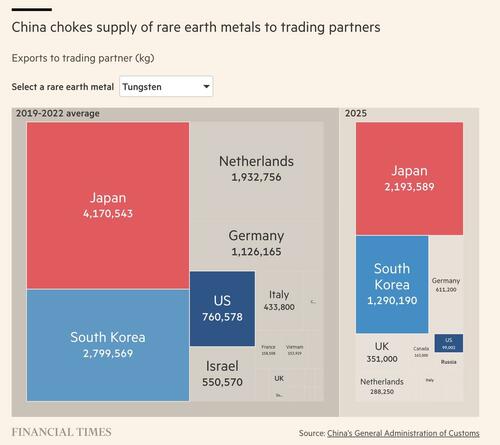
"The Killer Chokepoint": China's Rare Earth Squeeze Is Reshaping The Global Economy
China's control over rare earth elements, crucial for AI chip manufacturing, is reshaping the global economy and highlighting supply chain vulnerabilities.
Key takeaway
""The Killer Chokepoint": China's Rare Earth Squeeze Is Reshaping The Global Economy" — BullBear's AI rates this story as a mixed, direction-neutral signal, with a market-impact score of 85 out of 100. China's control over rare earth elements, crucial for AI chip manufacturing, is reshaping the global economy and highlighting supply chain vulnerabilities. Reported by ZeroHedge on July 17, 2026. The call is verified against the actual 24-hour price move on BullBear's public conviction ledger.
Get the next high-impact catalyst
Telegram alerts when our AI scores a story 80+/100 impact (~1-3 per day, no spam).
Verified 30d hit rate 50.7%.
Rewritten: Dollar likely to fall this week as rate hike bets decrease.
The dollar is expected to experience a weekly decline as traders reduce their bets on further interest rate hikes, indicating a potential shift in monetary policy expectations.
A retreat in dollar strength, driven by diminished expectations for aggressive Federal Reserve rate hikes, signals a potential shift in global liquidity flows. This development could foster a more risk-on environment, encouraging investors to seek out higher-yielding assets beyond the relative safety of the greenback. The market sentiment may pivot from a defensive posture, characterized by caution and a preference for established safe havens, towards a more optimistic outlook. This recalibration aligns with broader macroeconomic themes of moderating inflation and a plateauing interest rate cycle, which typically boost investor confidence. Consequently, a weaker dollar can embolden risk appetite, as the cost of borrowing decreases and the attractiveness of international investments increases, potentially leading to broader market rallies across various asset classes.
A Federal Reserve official warned that inflation is 'too hot' and has been for 'too long.'
A prominent Federal Reserve official's assertion that inflation has remained elevated for an extended period signals a potential shift in monetary policy expectations. This hawkish sentiment could weigh on broader market sentiment, fostering a more cautious outlook as investors anticipate continued restrictive measures. The connection to macro themes is clear, as persistent inflation challenges the narrative of a swift economic rebound and raises concerns about stagflationary pressures. Such commentary may erode investor confidence, prompting a recalibration of risk appetite. Consequently, assets perceived as more sensitive to interest rate hikes or economic slowdowns could face increased headwinds, while defensive sectors might see renewed interest as investors prioritize capital preservation. The emphasis on inflation's stubbornness suggests that the path to price stability remains a paramount concern for policymakers.
Rewritten: Here are a few options, keeping the meaning and constraints: * **Fed
The Fed must boost data security after an insider trading incident.
The recent conviction of a former Federal Reserve employee for insider trading underscores significant vulnerabilities within the institution responsible for managing national monetary policy. This breach of trust has immediate implications for broader market integrity, potentially eroding confidence in the fairness and transparency of financial markets. The incident casts a shadow over market sentiment, fueling anxieties about information asymmetry and the potential for illicit gains, which can dampen investor appetite for riskier assets. This development intersects with macro themes of regulatory oversight and the need for robust cybersecurity measures in critical financial infrastructure. Consequently, investor confidence may be shaken, leading to a more cautious approach and a potential recalibration of risk premiums across various asset classes as market participants await enhanced security protocols and assurances from the Fed.
Rewritten: Logan: Modest rate hikes increase pressure on risky investments.
Federal Reserve's Lorie Logan advocated for modestly higher interest rates, which increases pressure on risk assets.
Dallas Fed President Lorie Logan's recent remarks advocating for a continuation of modestly higher interest rates inject a cautious note into the market outlook. This stance suggests a persistent fight against inflation, potentially prolonging an environment of tighter monetary policy. Such a development could weigh on valuations for risk assets, as borrowing costs remain elevated and the cost of capital increases. Market sentiment may shift towards a more defensive posture, with investors reassessing their exposure to growth-oriented sectors. This aligns with broader macroeconomic themes of inflation control and the Federal Reserve's commitment to price stability, even at the risk of slower economic growth. Consequently, investor confidence could be tested, leading to a reduced appetite for speculative investments and a greater emphasis on capital preservation.
#macro
Get the next 80+ impact catalyst
Push notifications when our AI flags a high-impact bull/bear story. ~1–3 per day.