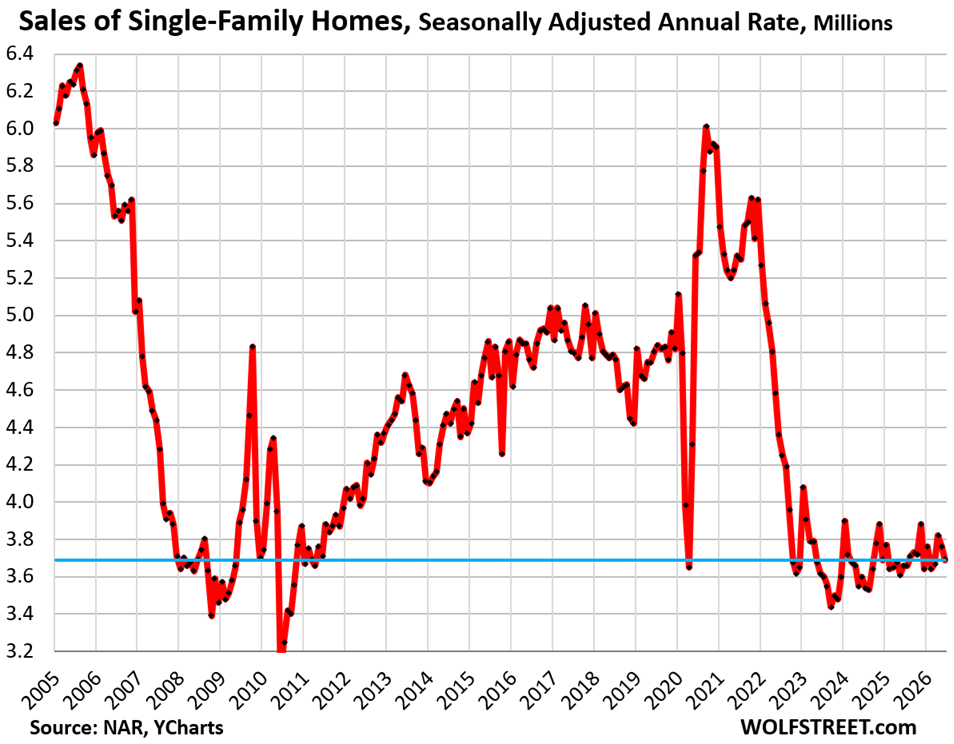
Sales of Existing Single-Family Homes Sink Deeper into Mud, Supply Jumps to 10-Year High, Condo Supply at 14-Year High
How this call is verified
▼ Bearish call was checked against the actual S&P 500 price 24h later: ✗ Miss (+0.49%).
Our record on calls like this
1,256 scored calls here, 46.3% right (±9.3pp). Always answering up would have scored 62.5% — so we are -16.2pp.
Bar: S&P 500 ±0.3% within 24h · every verdict lands on the public ledger
AI comment — why bearish
Existing home sales decline deepens the housing market's structural challenges, with inventory surging to decade highs for single-family units and 14-year peaks for condos. This supply glut, driven by elevated mortgage rates and affordability constraints, intensifies downward pressure on prices and accelerates seller frustration, signaling a prolonged correction beyond temporary seasonal dips. The data reinforces negative sentiment, shifting focus from scarcity to oversupply, which dampens consumer confidence in housing as a wealth asset. Macro-wise, it aligns with persistent high rates and slowing economic growth, reducing housing's role as a demand catalyst. Consequently, investor confidence in residential real estate weakens further, amplifying risk aversion as the sector faces extended price adjustment cycles, potentially diverting capital toward more resilient asset classes amid deteriorating fundamentals.
Key takeaway
"Sales of Existing Single-Family Homes Sink Deeper into Mud, Supply Jumps to 10-Year High, Condo Supply at 14-Year High" — BullBear's AI rates this story as a bearish (negative) signal for markets, with a market-impact score of 75 out of 100. Existing home sales decline deepens the housing market's structural challenges, with inventory surging to decade highs for single-family units and 14-year peaks for condos. This supply glut, driven by elevated mortgage rates and affordability constraints, intensifies downward pressure on prices and accelerates seller frustration, signaling a prolonged correction beyond temporary seasonal dips. The data reinforces negative sentiment, shifting focus from scarcity to oversupply, which dampens consumer confidence in housing as a wealth asset. Macro-wise, it aligns with persistent high rates and slowing economic growth, reducing housing's role as a demand catalyst. Consequently, investor confidence in residential real estate weakens further, amplifying risk aversion as the sector faces extended price adjustment cycles, potentially diverting capital toward more resilient asset classes amid deteriorating fundamentals. That score reflects how strongly the story is likely to move Bitcoin, US equities, the dollar, and gold, and near-duplicate coverage of the same event is clustered so only the representative article is scored. Reported by Wolf Street on August 11, 2026. The call is verified against the actual 24-hour price move on BullBear's public conviction ledger.
Catch the next bear flag
Telegram alerts when our AI scores a story 80+/100 impact (~1-3 per day, no spam). Verified 30d hit rate 46.3%.